

What Is DevOps? Principles, Practices, and Culture
DevOps is a culture and set of practices that unites software development and IT operations to ship reliable software faster. Here is the lifecycle loop, the core practices, the CALMS pillars, how DevOps relates to SRE, and why it is culture first, not a job title.
Definition
DevOps is a culture and set of practices that unites software development (Dev) and IT operations (Ops) to shorten the delivery cycle and ship reliable software faster. It breaks down the wall between "build it" and "run it" so the team that builds a system also runs it, replacing hand-offs and blame with shared ownership, automation, and continuous feedback.
For decades, development and operations were separate departments with opposing incentives. Developers were rewarded for shipping change; operations was rewarded for keeping things stable. Every release crossed a wall: Dev threw code over it, Ops caught it, and when something broke, each side blamed the other. AWS describes DevOps as the combination of cultural philosophies, practices, and tools that increases an organization's ability to deliver applications at high velocity, and the first word there is cultural. DevOps is the decision to tear that wall down.
The phrase that captures it best is "you build it, you run it", coined at Amazon to describe engineers carrying a pager for the services they write. When the same team owns a feature from the first line of code to the 3 a.m. incident, the incentives finally line up: you write more resilient code because you are the one who gets paged, and you fix operational pain fast because it is your pain. That single shift, from hand-off to shared ownership, is the whole idea. Everything else is the practices and tools that make it work at speed.
The DevOps lifecycle: the infinity loop
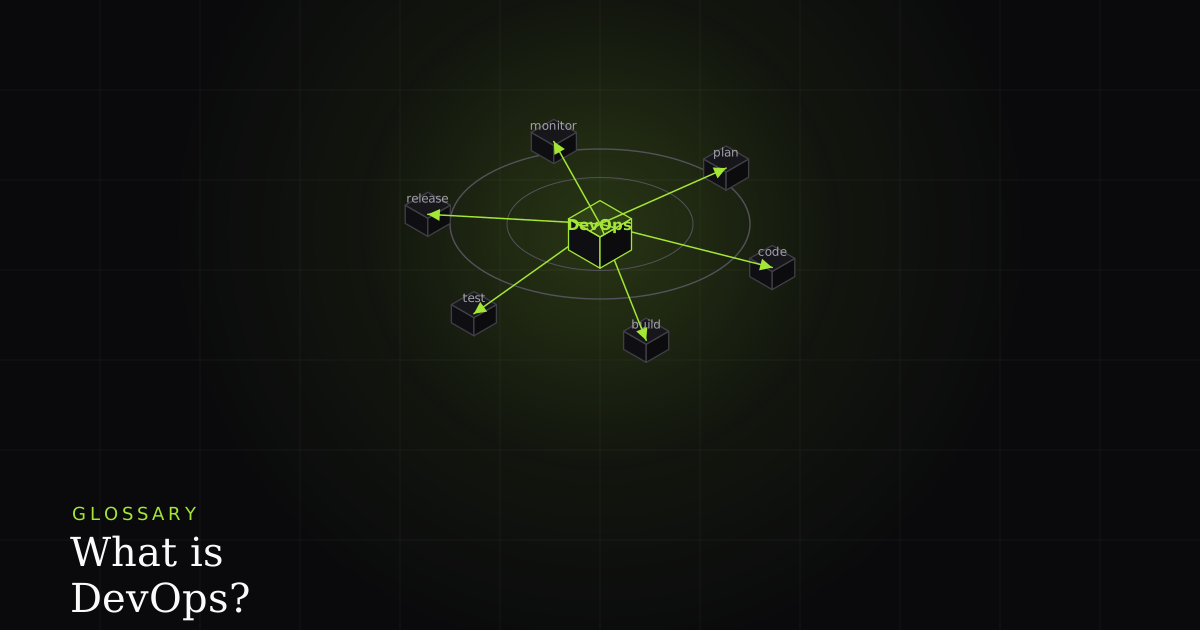
DevOps is almost always drawn as an infinity loop, and the shape is deliberate: the work never ends. The development half feeds the operations half, and the operations half feeds straight back into the next round of development. The eight stages are plan → code → build → test → release → deploy → operate → monitor, and then monitor loops back to plan. Plan, code, build, and test live on the Dev side; release, deploy, operate, and monitor live on the Ops side; the two meet in the middle where a tested change becomes a running system.
The loop matters because it reframes software as something you continuously improve rather than a project you finish and hand off. What you learn from operating the system (where it is slow, where it errors, what users actually do) is not a post-mortem footnote; it is the input to the next plan. A team that closes this loop tightly ships small changes often and learns from each one. A team that leaves it open ships big, rare, scary releases and re-learns the same lessons every quarter.
The core practices
Culture is the why; practices are the how. A handful of technical practices turn "you build it, you run it" from a slogan into a working pipeline. Continuous integration and continuous delivery (see what is CI/CD) automate the build-test-release-deploy segment of the loop so a merged change can reach production in minutes with tests as the gate. Infrastructure as code defines servers, networks, and config in version-controlled files, so environments are reproducible and a rollback is a git revert rather than a heroic night. Automated testing gives the pipeline the confidence to deploy without a human manually clicking through every path.
On the operations side, continuous monitoring and observability (see what is observability) turn a running system from a black box into something you can ask questions of, so you find out about a problem from your dashboards, not from angry users. And when something does break, blameless postmortems (see the blameless incident postmortem playbook) treat the incident as a systems failure to learn from rather than a person to punish. That last one is where practice and culture visibly fuse: blameless review is only possible in a team that already shares ownership.
DevOps vs SRE, and the DORA metrics
People often ask whether SRE competes with DevOps. It doesn't. Site Reliability Engineering is a specific implementation of DevOps principles. DevOps says "reduce the wall between Dev and Ops and share ownership of reliability"; SRE, pioneered at Google, gives you the concrete mechanisms: service level objectives and error budgets (see SLA vs SLO vs SLI), a hard cap on manual toil, and blameless postmortems. The often-quoted line is "class SRE implements interface DevOps": same goals, one prescriptive recipe.
To know whether any of this is working, teams turn to DORA metrics. Google Cloud's DORA research distilled software delivery performance into four measures: deployment frequency and lead time for changes (how fast you ship) balanced against change fail rate and time to restore service (how reliably you ship). The pairing is the insight: speed and stability are not a trade-off but rise together on healthy teams. For a practitioner's take on which numbers to actually track, see QA metrics that matter.
Benefits, and the honest caveats
Done well, DevOps delivers three compounding benefits: faster releases (small changes flow continuously instead of piling up into risky big-bang deploys), more reliable software (automated tests and observability catch problems early), and faster recovery when something does break. That last one has a name, MTTR (mean time to restore), and it is often a better health signal than trying to prevent every failure; the reduce-MTTR playbook digs into it. The whole point of the loop is that a system you can deploy and roll back in minutes is a system you can fix in minutes.
Where quality and feedback close the loop
The stage most teams under-invest in is the last one: monitor, and the feedback arrow that loops it back to plan. It is easy to instrument dashboards that tell you that something is wrong. It is much harder to turn a production signal (a spike in errors, a user complaint, a degraded flow) into a bug an engineer can actually reproduce and fix. A loop that surfaces problems but can't close them is only half a loop.
This is the narrow slice where BugMojo fits the DevOps picture: not as a monitoring platform, but as the thing that makes the monitor-and-feedback segment actionable. When a real user hits a problem, the browser extension captures the failing session with its rrweb replay, console output, and network requests, turning a vague "the app is broken" signal into a reproducible bug bundle. Feed that bundle to an AI coding agent, and the feedback arrow gets shorter: the loop's monitor stage produces a fixable ticket, not just a red line on a graph. The rest of the DevOps loop (CI/CD, IaC, observability) is well-served by mature tools; the reproduction gap is where good context earns its keep.
BugMojo captures the failing session with its rrweb replay, console, and network, then hands the whole bundle to Claude Code or Cursor over MCP, so the "monitor" stage of your loop produces a reproducible bug, not just an alert.
Install the extensionFrequently asked questions
Frequently asked questions
Sources
- What is DevOps? Culture, practices, and tools that increase delivery velocity, AWS (Amazon Web Services) (2026)
- DevOps: principles, practices, and the CALMS framework, Atlassian (2026)
- DevOps: definition, history, and the development-operations lifecycle, Wikipedia (2026)
- DevOps: capabilities and the four DORA delivery metrics, Google Cloud (DORA) (2026)
Get bug-tracking insights, weekly.
Engineering deep-dives, QA playbooks, and honest tool comparisons. No spam. Unsubscribe in one click.