

What Is an AI Agent? (Agentic AI Explained)
An AI agent is an LLM-based system that pursues a goal by looping (reasoning, calling tools, observing the result, and deciding the next step) instead of a single one-shot response. Here is how the agent loop works, why tools and MCP matter, and where agents fall short.
Definition
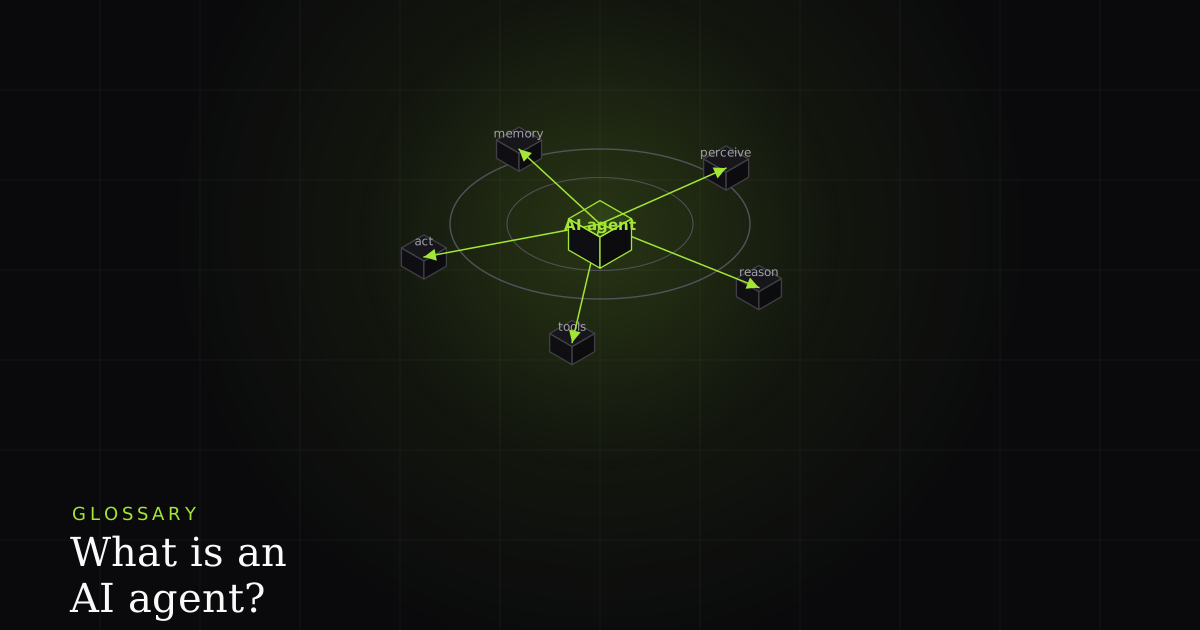
An AI agent is an LLM-based system that pursues a goal by looping (reasoning about what to do, calling tools to act, observing the result, and deciding the next step) until the goal is met. Unlike a one-shot chatbot, it acts autonomously across multiple steps, uses external tools, and keeps state along the way.
The word 'agent' predates today's LLMs. In classical AI an intelligent agent is anything that perceives its environment and acts upon it to achieve goals: a perceive-act loop. What changed is the engine. A modern AI agent puts a large language model at the center of that loop: the model is the part that reasons about the goal, chooses which action to take, and interprets what happened. Everything else (the tools, the memory, the control loop) exists to feed the model good information and carry out what it decides.
The one-sentence contrast that matters: a plain LLM call is one-shot (prompt in, text out, done), while an agent is iterative. It does not just describe what should happen; it takes a step, looks at the outcome, and takes another. Anthropic's engineering team draws exactly this line in Building Effective Agents, separating workflows, where the steps are orchestrated by hardcoded code paths, from agents, where the LLM 'dynamically directs its own processes and tool usage, maintaining control over how it accomplishes tasks.' That self-direction is the whole idea.
The agent loop
Strip an agent down and you find one repeating cycle. Receive a goal: a natural-language objective from a person or another system. Reason and plan: the LLM decides what to do next, sometimes breaking the goal into steps. Act via a tool: it calls an external capability (search the web, run code, query a database, edit a file). Observe the result: the tool's output is fed back into the model's context. Repeat: the agent uses that observation to choose the next action, looping until the goal is met or it decides to stop.
The loop is what makes an agent robust to the messiness of real tasks. A one-shot model has to be right on the first try because it never sees the consequences of what it said. An agent, by contrast, can run a command, notice it failed, read the error, and correct course, the same way a person does. That feedback is also where the risk lives: because each step is chosen from the previous observation, a bad observation or a poorly designed tool can send the whole loop in the wrong direction. Good agents are as much about the loop and the tools as about the model itself.
Agent vs. chatbot vs. single LLM call
Three capabilities separate an agent from a chatbot or a bare model call. The first is autonomy over multiple steps: an agent keeps working toward the goal, choosing each next action itself, rather than stopping after a single reply. The second is tool use: the ability to call external systems and actually change or fetch state in the world, not merely produce text about it. The third is memory and state across steps: what the agent observed two steps ago informs the decision it makes now. Remove all three and you are back to a chatbot that talks about doing things without doing them.
| Feature | Capability | AI agent | Chatbot / single LLM call |
|---|---|---|---|
| Runs multiple steps autonomously toward a goal | No | ✓ | No |
| Calls external tools to act on the world | No | ✓ | No |
| Keeps state / memory across steps | No | ✓ | Within one context only |
| Reacts to the outcome of its own actions | No | ✓ | No |
| Returns a single response and stops | No | No | ✓ |
Tools and MCP: how an agent acts
An agent is only as capable as the tools it can call. The LLM supplies the reasoning, but a model that cannot touch anything outside its own text is just a very articulate chatbot. Tool use (usually implemented as function calling) is the mechanism: the model emits a structured request to run a named tool with specific arguments, an external system executes it, and the result flows back into the loop. Every meaningful thing an agent does (reading a file, running a test, sending a message) happens through a tool call.
The friction has always been that each tool needed its own bespoke integration, re-implemented for every agent. The Model Context Protocol (MCP) is the emerging open standard that fixes that. Anthropic introduced MCP as a universal, open way to connect AI systems to the tools and data they need, 'like a USB-C port for AI applications.' Publish a capability once as an MCP server and any MCP-aware agent (Claude, Cursor, and others) can use it. For a fuller walkthrough, see our developer's primer on MCP. In short: function calling is how an agent acts, and MCP is how those actions get standardized and shared across agents.
Levels of autonomy, and a concrete example
Agency is a spectrum, not a switch. At one end sits a human-in-the-loop assistant that proposes each action and waits for you to approve it: lightly agentic, low stakes. At the other end sits a more autonomous agent that runs many steps on its own and only reports back at the end. Neither is inherently better. More autonomy buys speed and scale, but it also raises the stakes on tool design and guardrails, because the system takes more consequential actions before any human reviews them. A tool that can delete data is fine behind a confirmation and dangerous in a fully autonomous loop.
Make it concrete with an on-brand example: a coding agent fixing a bug. It reads the bug report, a tool call that pulls in the failure and its context. It reasons over the code, forming a hypothesis about the cause. It proposes a fix, editing the relevant files. And it may open a pull request (another tool call) for a human to review. Each of those steps is the loop in action: act, observe, decide. We break this exact workflow down in how AI agents fix bugs with MCP, and go deeper on the practice in debugging with AI agents.
Honest limits
This is why the best-performing agents rarely have the fanciest model and the most tools. They have the right tools, clear goals, and guardrails matched to their autonomy. Anthropic's guidance lands in the same place: start with the simplest thing that works, add agentic autonomy only when the task genuinely needs it, and invest in the tool interfaces the agent depends on. An agent's failures are usually not the model being 'dumb'; they are missing context, an ambiguous goal, or a tool that returned something the model could not act on.
Where BugMojo fits
Follow the coding-agent example to its weakest link. When an agent sets out to fix a bug, its very first step ('read the bug') is only as good as what the bug report actually contains. Hand it a one-line 'checkout is broken' and the agent is reasoning in the dark; it will guess, loop, and likely go off-track, which is exactly the failure mode above. The limit is not the model. It is the context the tool call returns.
That is the gap BugMojo closes. The browser extension captures a real reproduction (an rrweb session replay, the console output, and the network requests behind the failure) and exposes that whole bundle to any agent over MCP. So when a coding agent calls its 'read the bug' tool, it gets the actual failing state, not a vague summary. The agent reasons over real evidence, and its fix has something concrete to be right about. Agents fixing bugs need real reproduction context; BugMojo is the tool that supplies it.
BugMojo captures the failing session (rrweb replay, console, and network) and exposes it to Claude Code, Cursor, or any agent over MCP, so the agent's first tool call returns real reproduction context instead of a vague summary.
Install the extensionFrequently asked questions
Frequently asked questions
Sources
- Building effective agents: the distinction between workflows and agents, and how agents direct their own tool use, Anthropic (2024)
- Intelligent agent: the classic definition of an agent that perceives its environment and acts upon it, Wikipedia (2026)
- Model Context Protocol introduction: an open standard for how agents access tools and data, Model Context Protocol (2026)
- Introducing the Model Context Protocol: an open standard for connecting AI agents to tools and data, Anthropic (2024)
Get bug-tracking insights, weekly.
Engineering deep-dives, QA playbooks, and honest tool comparisons. No spam. Unsubscribe in one click.