

How AI Coding Agents Actually Fix Bugs (With MCP)
"The AI agent fixed the bug" gets said like a magic trick. It isn't one. Underneath, it's a tool-calling loop over structured context, and the structure of that context is the whole story.
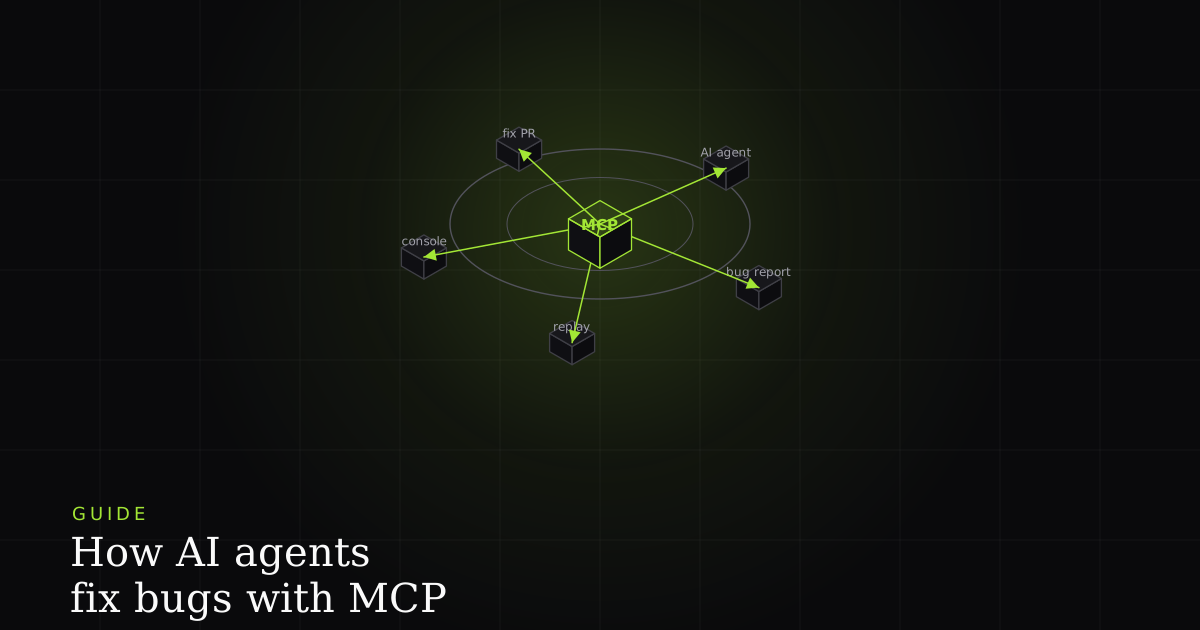
"The AI agent read the bug and fixed it" has become a stock sentence, said the way people used to say a build "just worked." It gets treated as a small miracle: the model somehow understood the problem and produced code. It isn't a miracle, and understanding the actual mechanics matters, because the mechanics are exactly where most of these workflows quietly fail.
Underneath the sentence is something much more ordinary: a tool-calling loop over structured context. The agent asks a server what it can do, calls one of those capabilities, gets back data, and reasons over that data next to the codebase it already has open. That's it. No hidden understanding of your product, no telepathy about what "checkout is broken" means. Just a request, a structured response, and a language model doing what language models do with whatever text lands in front of it. This piece walks through that loop concretely: the actual calls, the actual payload shape, and the one variable that determines whether the output is a real fix or a plausible-looking guess.
What MCP actually is
The Model Context Protocol is an open standard, published by Anthropic in November 2024, that defines how an LLM-based agent discovers and calls external tools and resources through a client-server architecture. It's often described as "USB-C for AI apps": one connector shape instead of a bespoke integration per tool. MCP standardizes the wire format; it says nothing about what any given server chooses to put on it.
Before MCP, every integration between an AI coding assistant and an external system (a bug tracker, a database, a design tool) was its own bespoke plumbing: a custom API wrapper, a one-off prompt format, glue code that broke the moment either side changed. MCP replaces that with a single client-server protocol. A server exposes a set of tools (typed, callable functions), resources (readable data), and sometimes prompts, and any MCP-compatible client (Claude Code, Cursor, Windsurf, and others) can connect to it, discover what it offers, and call it, all in the same shape regardless of which server it's talking to.
That standardization is why the ecosystem moved fast after the November 2024 launch: a tool builder writes one MCP server instead of N bespoke integrations, and it works with every client that speaks the protocol. But it's worth being precise about what that buys you. MCP is a transport and a discovery mechanism. It does not decide what a get_bug tool returns, how detailed a stack trace is, or whether a session replay is attached. Those decisions belong entirely to whoever built the server, which is exactly the point this piece keeps coming back to.
The actual loop, step by step
Strip away the framing and here is what actually happens, in order, when an agent "fixes a bug via MCP":
- Connect and discover. The agent's client (say, Claude Code) connects to an MCP server (a bug tracker, in this case) and sends a
tools/listrequest. The server replies with its available tools and their typed schemas:get_bug,search_bugs,update_bug, and so on, each with a description and the exact fields it accepts. - Call a tool, get structured context back. The model decides to call
get_bugwith an ID. Critically, what comes back is not a one-line text description. In a well-built server it's a structured bundle: the report itself, a console log, the network requests around the failure, the DOM state or a session replay, and, if the reporter or tool captured it, a reliable set of repro steps.
Steps three through five are where the actual engineering happens, and they look almost exactly like what a human does when handed a good bug report:
- Reason over the context, next to the code. The agent already has the repository open. It reads the returned reproduction against the source it can see (the failing request against the route handler that serves it, the console error against the component that threw it) and forms a hypothesis about the actual cause.
- Propose or write a fix. The agent edits the code, same as it would from any other prompt. Nothing about MCP changes how the fix itself gets written. It only changed what the agent knew before it started writing.
- Call another tool to close the loop. The agent calls
update_bugoradd_commentto move the ticket's status, attach the diff or PR link, and record what it changed and why, using the same channel a human teammate would use.
// request — the agent calls get_bug, not a search engine
{
  "jsonrpc": "2.0", "id": 7, "method": "tools/call",
  "params": { "name": "get_bug", "arguments": { "id": "bug_9K2p" } }
}

// response — content[].text carries structured reproduction, not a title
{
  "jsonrpc": "2.0", "id": 7,
  "result": {
    "content": [{
      "type": "text",
      "text": "{\n  \"title\": \"Checkout throws on coupon apply\",\n  \"stepsToReproduce\": [\"Add item to cart\", \"Apply coupon SAVE10\", \"Click checkout\"],\n  \"consoleErrors\": [\"TypeError: Cannot read properties of undefined (reading 'amount')\"],\n  \"networkRequests\": [{ \"url\": \"/api/v1/coupons/apply\", \"status\": 500 }],\n  \"replayUrl\": \"https://www.bugmojo.com/replay/bug_9K2p\",\n  \"environment\": { \"browser\": \"Chrome 128\", \"url\": \"/checkout\" }\n}"
    }]
  }
}

// the agent now has a failing request, a stack-adjacent error, and a
// replay URL to inspect — not a one-line title to guess from
The part everyone glosses over: context quality
Context quality determines fix quality far more than model capability does. An agent handed "checkout is broken" has to guess at the failure mode and produces a plausible-looking patch aimed at the wrong cause. An agent handed a session replay, the console error, and the failing network request can target the actual bug on the first pass, because the ambiguity that produces a wrong guess was never there to begin with.
This is the load-bearing point of the whole piece, and it's easy to miss because the failure mode looks like a model problem. The 2025 Stack Overflow Developer Survey found that 66% of developers name "AI solutions that are almost right, but not quite" as a top frustration, the single most-cited complaint about working with AI coding tools. The instinctive read is that the model isn't smart enough yet. Look at the mechanics above and a different explanation fits better: an "almost right" fix is exactly what you'd expect from step 3 of the loop when step 2 handed back too little to reason from.
A model that receives "checkout is broken" has no failing request, no error message, no reproduction. It pattern-matches against the most common causes of checkout bugs in general and writes a fix aimed at the most statistically likely one. Sometimes that's right. Often it's almost right: a real bug, a plausible fix, the wrong bug. Swap that input for a console error, the specific failing endpoint, and a replay of the exact click sequence, and the same model is no longer pattern-matching against "checkout bugs in general." It's looking at the one that actually happened. Nothing about the model changed between those two runs. Only the context did.
Who's actually shipping this
None of this is speculative. The infrastructure for this loop exists today across the tools most teams already use. Atlassian's Rovo MCP Server reached general availability in 2025, letting agents read and write Jira issues and Confluence pages directly instead of through a human copying fields between tabs. Linear exposes an MCP server that surfaces issues and their metadata to connected agents. Sentry's MCP server lets an agent query production errors and stack traces from inside the editor. GitHub's MCP tooling gives agents direct access to issues, pull requests, and code search. And BugMojo's MCP server, covered in depth in how the BugMojo MCP server works, exposes bug data the same way.
This isn't a comparison post and the list above isn't exhaustive or ranked. The point is narrower: "an AI agent fixes bugs by calling tools over MCP" describes real, shipping plumbing across the tracker and monitoring tools most engineering teams already have open, not a future capability someone is still building toward.
The honest limits of MCP
It's worth being just as clear about what MCP doesn't do, because the framing above can slide into sounding like a solved problem. It isn't.
MCP doesn't make an agent omniscient. It gives an agent a standardized way to ask for context that exists, but it can't hand back a reproduction that was never captured. If nobody recorded the console log or the failing request, get_bug returns the same thin ticket a human would have written, and the agent is back to guessing regardless of how clean the protocol handshake was.
The tool schema matters as much as the protocol. A get_bug tool that returns only a title and a free-text description is a badly designed tool, and it produces exactly the same near-miss fixes as a vague bug report, MCP or not. The protocol standardizes how the agent asks; it has no opinion on what the server is willing to give back. A team that wires up an MCP server and stops there, without thinking about what fields actually help an agent reason, has built a faster way to hand an agent bad context, not a better one.
And a human, or a capture tool, still has to decide what gets recorded in the first place. MCP moves data that already exists between a server and a client efficiently; it has no mechanism for deciding that a network request or a DOM state was worth saving at the moment the bug happened. That decision is made upstream, before the agent ever sends a tools/call.
How BugMojo applies this
BugMojo's MCP server is built around exactly the gap described above. The design choice isn't which tools to expose. Most bug-tracker MCP servers converge on a similar set of verbs: get, list, search, update. The choice is what a call to get_bug hands back. Instead of a title and a free-text description, the response carries the full reproduction the extension captured at the moment the bug happened: an rrweb session replay, the console log, the network waterfall, and the environment, assembled automatically, not typed up from memory after the fact.
That's the direct, practical consequence of the context-quality argument above. An agent calling BugMojo's get_bug isn't reasoning from a guess at what "checkout is broken" might mean; it's reasoning from the actual failing request and the actual console error, the same inputs a senior engineer would ask for before touching the code. That's why, in practice, the agent's first attempt is more often the right one instead of an "almost right" one, not because the underlying model got smarter, but because the context it received stopped requiring it to guess. For the mechanics of the server itself (the 14 tools, the transport, the polymorphic assignee that lets an agent own a bug the way a human teammate does), see how the BugMojo MCP server works.
BugMojo's MCP server hands get_bug calls back a full reproduction (session replay, console, and network), so your AI agent's first fix attempt is more often the right one.
Install the free extensionFrequently asked questions
Frequently asked questions
Sources
- Anthropic's original announcement introducing the Model Context Protocol as an open standard for connecting AI assistants to external systems, Anthropic (2024)
- The official MCP introduction describing the client-server architecture and the tools, resources, and prompts primitives, Model Context Protocol (2026)
- Overview of MCP's architecture and its adoption across major AI coding tools since its November 2024 release, Wikipedia (2026)
- 2025 Developer Survey: 66% of developers cite 'AI solutions that are almost right, but not quite' as a top frustration, Stack Overflow (2025)
- Atlassian's Rovo MCP Server reaching general availability, letting agents read and write Jira and Confluence directly, Atlassian (2025)
Get bug-tracking insights, weekly.
Engineering deep-dives, QA playbooks, and honest tool comparisons. No spam. Unsubscribe in one click.