

Bug Tracking Best Practices: 12 Rules for Fast-Moving Teams
Most bug-tracking advice is either vague ('write clear tickets') or bloated ('here are 47 fields'). These are 12 concrete rules for filing, triaging, and closing that actually move resolution time, grounded in the research on what makes a report useful.
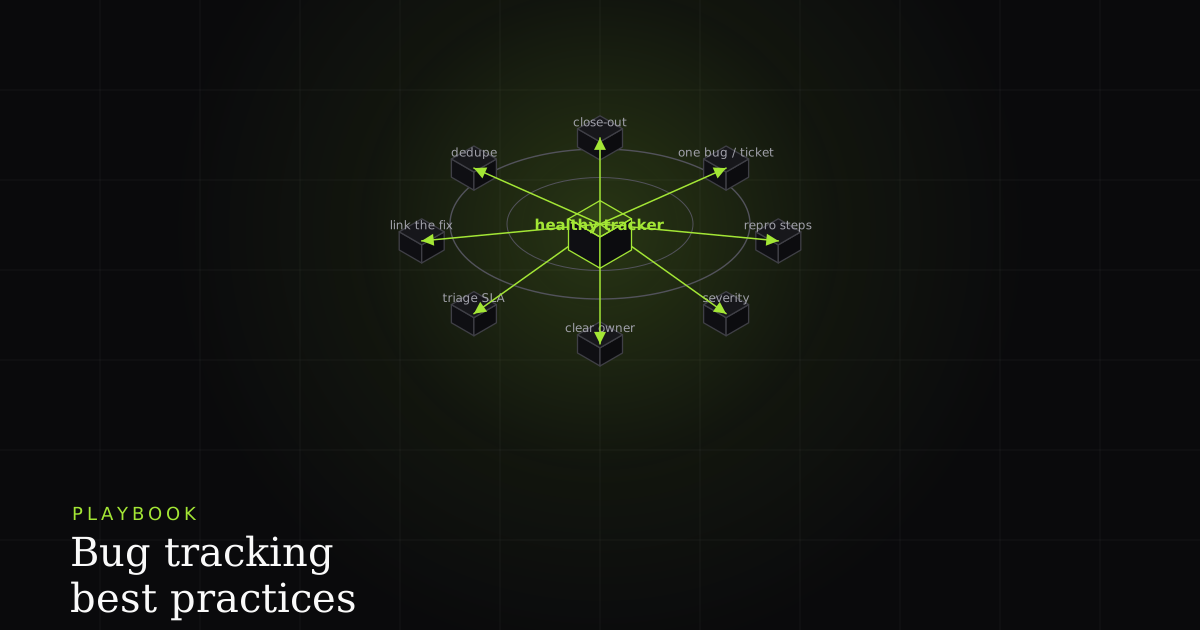
Most bug-tracking advice fails in one of two directions. It's either too vague to act on ("write clear tickets," "prioritize ruthlessly") or it's a wall of process that assumes you have a dedicated QA org and infinite patience for fields. Neither helps a small team that ships every day and just wants bugs to stop falling through the cracks.
What follows is 12 concrete rules, grouped by the three moments where bug tracking actually happens: filing a bug, triaging the backlog, and closing the loop. Each is a rule you can adopt this week, and where the research backs it up, it's cited. The goal isn't a heavier process. It's a lighter one that loses fewer bugs.
Filing: get the report right at the source
The most valuable part of a bug report is a reliable way to reproduce it. A survey of 466 developers across the Apache, Eclipse, and Mozilla projects found that steps to reproduce and stack traces are rated most useful and are simultaneously the hardest for reporters to provide. Fix filing first and everything downstream gets cheaper.
1. One bug per ticket. Never bundle several issues into one report. Bundled tickets can't be prioritized, assigned, or closed independently: the whole thing stays open until the least important item is done, and unrelated fixes collide in review. If you spot a second problem while filing, open a second ticket and cross-link. Splitting is cheap; untangling later is not.
2. Every bug needs reproduction steps. This is the single highest-leverage rule, and it's the one research is most emphatic about. In the 466-developer survey, steps to reproduce topped the list of what developers need, and they also topped the list of what reporters struggle to supply. A follow-up study of real bug trackers found that steps to reproduce, test case, stack trace, and expected behavior are exactly the elements most often omitted. This is the "information mismatch": the highest-value fields are the most-often-missing fields. No repro, no ticket.
3. Capture context, don't describe it. The reason repro steps go missing is that people are asked to reconstruct them from memory after the fact. Don't. Attach the actual session (a DOM replay, the console log, the network waterfall, the environment) so the report carries the real conditions instead of a paraphrase of them. A study assessing the quality of reproduction steps found that better steps correlate directly with faster resolution, and nothing produces better steps than a recording of what actually happened.
4. Write a title that states the defect. "It's broken" or "login page issue" tells triage nothing. A good title names the actual defect and where it happens: "Checkout submits twice when the Pay button is double-clicked on Safari." Someone scanning the backlog should understand the bug (and roughly how bad it is) without opening it. Titles are the index of your tracker; vague ones make the whole backlog unsearchable.
Triaging: decide fast, decide honestly
5. Separate severity from priority. Severity is impact: how badly the defect breaks the product when it occurs. Priority is urgency: how soon it should be fixed relative to everything else. The ISTQB glossary keeps these as distinct terms for a reason: they're independent axes. A typo on the pricing page is low severity but high priority; a rare crash in an admin tool nobody uses is high severity but low priority. Collapse them into one "importance" number and you'll systematically mis-schedule work. Track them as two fields. The full reasoning is in our severity vs priority decision framework.
6. Assign a single, clear owner. A bug owned by "the team" is owned by no one. Every triaged bug gets exactly one owner who is accountable for its next move. That owner doesn't have to be a human. With a polymorphic assignee model an owner can be a person or an AI agent, as long as the field is never empty and never a committee. Ambiguous ownership is how bugs sit untouched for weeks while everyone assumes someone else has it.
7. Triage on a cadence with an SLA. Untriaged backlogs rot. Set a standing rhythm (daily for production issues, a couple of times a week otherwise) and an SLA for first response so nothing sits unlooked-at past a known limit. Triage is a decision, not a status: every new bug leaves the meeting with a severity, a priority, and an owner. If you want a repeatable drill, we wrote up how to triage production bugs in 15 minutes.
8. Deduplicate before you file. Search first. Re-filing a bug that already exists splinters the discussion, the repro, and the fix history across two tickets, and it inflates your counts so the data lies to you. If you find an existing report, add your context to it and link. Don't open a fresh one. A quick search before every file is the cheapest quality control in the whole process.
Closing the loop: don't lose the thread
9. Keep a tight, meaningful status workflow. Too many statuses is as bad as too few. Fifteen states nobody can define means every ticket is in the wrong one; three states means you can't tell "waiting on repro" from "waiting on review." Pick the smallest set that maps to real decisions (something like New → Triaged → In Progress → In Review → Verify → Closed) and make sure every transition means something. Our bug lifecycle workflow walks through a default that most teams can adopt as-is.
10. Link the fix to the ticket. Every bug should be traceable end to end: the ticket links to the commit or pull request that resolved it, and ideally the PR references the ticket back. Six months later when a regression appears, that link is the difference between "here's exactly what changed and why" and an afternoon of git archaeology. Traceability is nearly free to create at fix time and expensive to reconstruct after.
11. Verify before closing. A bug isn't closed because a fix merged. It's closed because someone confirmed the bug is actually gone, in the environment where it happened. Merging is a claim; verification is evidence. This is exactly where the attached reproduction pays off a second time: whoever verifies can replay the original session's steps and check the defect no longer occurs, instead of guessing at what "fixed" was supposed to mean.
12. Treat reopens and "cannot reproduce" as a signal. A rising reopen rate or a growing pile of "works for me" closures is data about your process, not a verdict on your testers. It almost always means reports are arriving without enough context to recreate the bug. Review those tickets periodically and ask what was missing. The answer is usually the repro, the environment, or the triggering data. Fix the intake and the reopen rate falls on its own.
Step back and the 12 rules collapse into two. Almost everything on the filing side reduces to attach the reproduction (the steps, the replay, the console, the network, the environment), so the report is complete by construction instead of by the reporter's diligence. Almost everything on the triage and closing side reduces to make ownership and state explicit: one owner, honest severity-versus-priority, a tight workflow, and verification before close.
That's not a coincidence, and it's also the shape of the tooling gap the research keeps pointing at. The Bettenburg survey blamed the information mismatch on missing tools, not lazy reporters. When the two hardest rules to follow by hand (capturing a real reproduction and pinning down an accountable owner) are built into the tool instead, the other ten get much easier to keep.
Install the free BugMojo extension and capture the reproduction, console, network, and environment in one click, then assign it to a teammate or an AI agent over MCP. The best practices become automatic.
Install the free extensionFrequently asked questions
Frequently asked questions
Sources
- Bettenburg, Just, Schröter, Weiss, Premraj, Zimmermann: 'What Makes a Good Bug Report?' Survey of 466 developers/users (Apache, Eclipse, Mozilla): steps to reproduce & stack traces are most useful yet hardest for reporters to provide, Saarland University / Microsoft Research (2008)
- 'The significance of bug report elements' (Empirical Software Engineering): reporters most often omit steps to reproduce, test case, stack trace, and expected behavior, Empirical Software Engineering (Springer) (2020)
- 'Assessing the quality of the steps to reproduce in bug reports' (ESEC/FSE): better reproduction steps correlate with faster resolution, ACM ESEC/FSE (2019)
- ISTQB Glossary: standard definitions of defect, severity, and priority terminology used across the testing industry, ISTQB (2026)
Get bug-tracking insights, weekly.
Engineering deep-dives, QA playbooks, and honest tool comparisons. No spam. Unsubscribe in one click.