

What Is Behavior-Driven Development (BDD)?
BDD extends test-driven development by describing software behavior in plain, structured language that business and technical people share, so everyone agrees on what "done" means before a line of code is written. Here is where it came from and how Given-When-Then works.
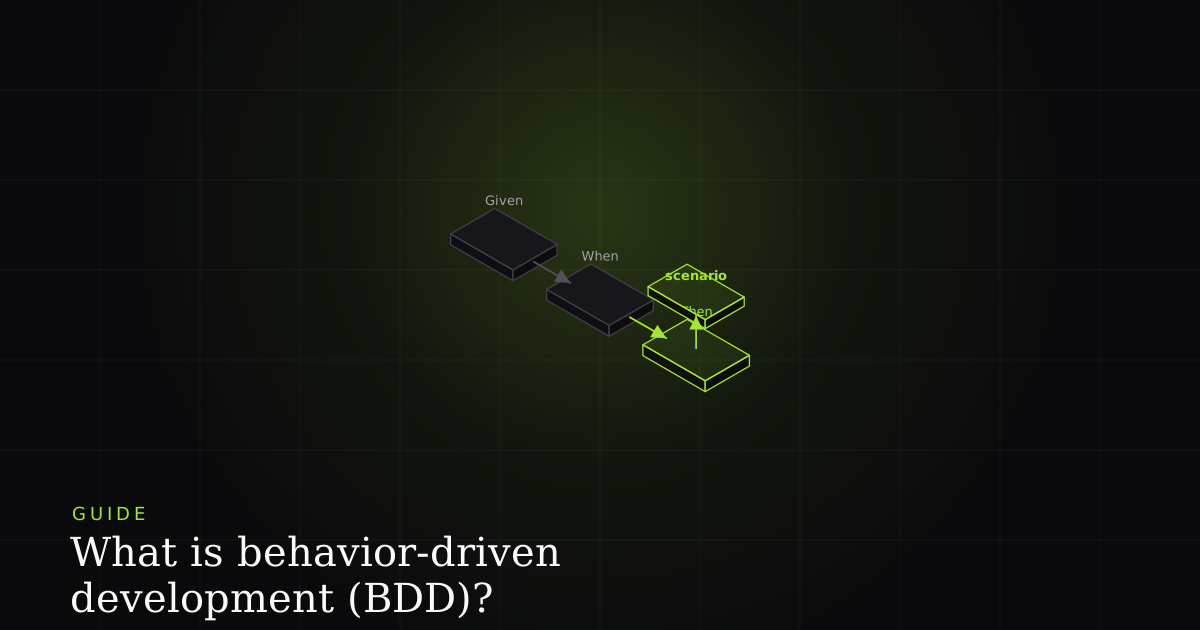
Most software failures are not bugs in the strict sense. The code did exactly what it was told. The failure is that what it was told to do was never what anyone actually wanted, and nobody noticed until it shipped. Behavior-driven development is a direct response to that gap. BDD is a collaborative practice that extends test-driven development by describing software behavior in plain, structured language that business and technical people share, so the whole team agrees on what "done" means before a line of code is written, not after a demo goes sideways.
The word that matters most in that definition is collaborative. BDD is often mistaken for a testing framework or a special syntax, and teams adopt the syntax while skipping the collaboration, which is like buying running shoes and calling it exercise. This guide walks through where BDD came from, the Given-When-Then structure at its core, the conversation that gives it value, how it differs from TDD and from acceptance criteria, the tools that automate it, and the honest caveats about when it earns its keep and when it does not.
Where BDD came from
Behavior-driven development is a collaborative practice, introduced by Dan North around 2006, that describes software behavior in plain, structured language shared by business and technical people. It extends test-driven development so the whole team agrees on what "done" means before code is written.
BDD was coined by Dan North in the mid-2000s, and it started as a teaching problem. North was helping developers learn test-driven development and kept hitting the same wall: the word "test." People got stuck on three questions. Where do I start? What should I actually test? What do I name the test so it says something useful? The vocabulary of TDD (units, assertions, test methods) pointed inward at the code and gave no help answering them.
North's insight was to change the language. Instead of writing a test called testUserLogin, describe a behavior: "the user should be taken to their dashboard after signing in." That single shift, from testing code to specifying behavior, dissolved the three questions. You start with the most valuable behavior; you test what the system should do; and the name is just the behavior, written as a sentence. BDD grew from that reframing into a full practice: a shared, business-readable language for describing behavior, and tooling to turn those descriptions into automated checks. The point was never to replace TDD but to give it a vocabulary that non-programmers could join.
The Given-When-Then structure
The heart of BDD is a template for describing one concrete example of a behavior. It has three parts, and they are usually written in a plain-language syntax called Gherkin:
- Given: the context or precondition. The state the system is in before anything happens.
- When: the action or event. The single thing that triggers the behavior.
- Then: the expected outcome. The one observable result you assert should be true afterward.
Read together, a Given-When-Then scenario is a tiny, unambiguous specification: in this situation, when this happens, this is what should be true. A scenario lives inside a .feature file that names the feature and its business value. Here is a real example for an online shopping basket:
Feature: Free shipping threshold
  As a shopper
  I want free shipping once my basket is large enough
  So that I am rewarded for a bigger order

  Scenario: Basket qualifies for free shipping
    Given a shopper has items worth $60 in their basket
    And the free shipping threshold is $50
    When they proceed to checkout
    Then shipping is shown as "FREE"
    And no delivery charge is added to the total

  Scenario: Basket is below the threshold
    Given a shopper has items worth $40 in their basket
    And the free shipping threshold is $50
    When they proceed to checkout
    Then a $5 delivery charge is added to the total
Notice that a non-programmer can read every line and agree or object to it. That is deliberate. It is the whole point. But the scenario is not just prose. Each step maps to a step definition: a small piece of code, in whatever language the team uses, that knows how to execute that line against the real system. When the scenario runs, the tool matches each Given/When/Then line to its step definition and executes it, turning the plain-language example into an automated test.
import { Given, When, Then } from '@cucumber/cucumber';
import { strict as assert } from 'node:assert';

Given('a shopper has items worth ${int} in their basket', function (amount) {
  this.basket = createBasket({ subtotal: amount });
});

Given('the free shipping threshold is ${int}', function (threshold) {
  this.threshold = threshold;
});

When('they proceed to checkout', function () {
  this.result = checkout(this.basket, { freeShippingOver: this.threshold });
});

Then('shipping is shown as {string}', function (label) {
  assert.equal(this.result.shippingLabel, label);
});
The same words the business signed off on now drive the test. If the code stops giving free shipping over $50, the scenario fails, and it fails in language everyone understands, not in a stack trace that only a developer can read.
The three amigos and a ubiquitous language
Here is the part teams skip, and skipping it is why so many BDD adoptions quietly fail. Scenarios are not meant to be written by one person, least of all a developer, alone, after the fact. They are meant to come out of a conversation among the "three amigos": someone who represents the business or product (what problem are we solving?), a developer (how would we build it, and what's hard?), and a tester or QA (how could this break, and what edge cases matter?).
When those three roles work through examples together (before building), three things happen. Ambiguities surface while they are still cheap to fix. Edge cases nobody would have thought of alone get named. And the team converges on a ubiquitous language: a shared vocabulary where "basket," "threshold," and "checkout" mean exactly one thing to everyone, and that same vocabulary flows straight into the scenarios, the code, and the conversations. The Gherkin file is the artifact of that conversation, but the conversation is the product. This is why practitioners insist that BDD's value is the discovery workshop, not the syntax that records its output.
BDD vs TDD, and BDD vs acceptance criteria
Two comparisons clear up most of the confusion around BDD.
BDD vs TDD. Test-driven development is developer-facing and works from the inside out: write a failing unit test, make it pass, refactor, repeat. Its concern is the correctness and design of a unit of code. BDD is business-facing and works from the outside in: start from an observable behavior the business cares about, described in shared language, and let that drive what you build underneath. TDD asks "is this function right?"; BDD asks "does the system do what we agreed it should?" They compose cleanly: many teams frame the outer behavior with BDD and then use TDD to build the units inside it. If you want the developer-facing half in depth, see our guide on test-driven development, and our breakdown of unit vs integration vs end-to-end testing for where each layer sits.
BDD vs acceptance criteria. Acceptance criteria are the conditions a feature must satisfy to be accepted, often written on a user story. BDD scenarios are a way of expressing acceptance criteria as concrete, executable examples. Plenty of teams write acceptance criteria as bullet points; BDD says, write them as Given-When-Then examples instead, so they are unambiguous and can be automated. The two are complementary, not competing: sharp criteria feed straight into scenarios. Our guide on writing acceptance criteria that prevent bugs covers the front half of that pipeline, and BDD is one disciplined form the back half can take. Where those accepted behaviors are validated by real users, you cross into user acceptance testing.
Tools and living documentation
A family of tools runs Gherkin scenarios as tests by wiring steps to code. Cucumber is the best known (with variants across Java, JavaScript, Ruby, and more); SpecFlow brought the same model to .NET; Behave is a common choice in Python. They differ in ecosystem, not in idea: parse the plain-language scenarios, match each step to a definition, execute, report pass or fail in the language of the feature.
The payoff beyond automation is living documentation. Because the scenarios are executable, they cannot rot the way a wiki page does. A stale document lies silently; a stale scenario fails. That makes the feature files a description of how the system behaves today that is continuously verified against the actual system: the closest thing software has to documentation that is guaranteed current. New team members read the .feature files to learn what the product does, and trust them, because CI proves them on every run.
Honest caveats: when BDD is overkill
None of these are reasons to avoid BDD. They are reasons to adopt it for the right reason. BDD earns its keep on features where business and technical people genuinely need to agree on behavior, and where that agreement is worth writing down as executable examples. It does not earn its keep as a mandatory syntax layered over every unit test. Reach for it when the risk is misunderstanding what to build, not when the risk is a bug in how a single function computes.
From agreed behavior to a real reproduction
BDD gives you a precise statement of expected behavior: Given this context, When this happens, Then this is what should be true. That is enormously useful right up until the moment production disagrees with it: a real user, in a real browser, hits the Given, does the When, and sees something other than the Then. At that point the scenario tells you what should have happened, but not what actually did, and the distance between those two is where debugging lives.
That is the loop BugMojo closes. Your scenarios define the expected behavior; when real behavior diverges for a user, a captured reproduction shows exactly how: a session replay of the steps that led to the divergence, plus the console and network activity at the moment it broke. You are no longer reconstructing the failing Given-When-Then from a vague report; you are watching the actual sequence that violated it, ready to hand to a developer or an AI agent. The specification says what should be true; the capture shows precisely where reality parted ways with it.
Your BDD scenarios define what should happen. When a real user hits something else, BugMojo captures the session replay, console, and network in one click: the exact reproduction, ready for a developer or an AI agent over MCP.
Install the free extensionFrequently asked questions
Frequently asked questions
Sources
- Introducing BDD: Dan North's original article coining behavior-driven development and explaining how it evolved from TDD, Dan North (2026)
- BDD: the Cucumber team's documentation on behavior-driven development, discovery workshops, and Gherkin scenarios, Cucumber (2026)
- Behavior-driven development: overview of BDD's history, principles, and Given-When-Then vocabulary, Wikipedia (2026)
- BDD: the Agile Alliance glossary definition of behavior-driven development, Agile Alliance (2026)
Get bug-tracking insights, weekly.
Engineering deep-dives, QA playbooks, and honest tool comparisons. No spam. Unsubscribe in one click.