

What Is Shift-Left Testing?
Shift-left testing means moving testing earlier (to the left of the software lifecycle) so defects are caught in requirements, design, and coding instead of at the end. Here is where the idea came from, the economics behind it, and what it looks like in practice.
Definition
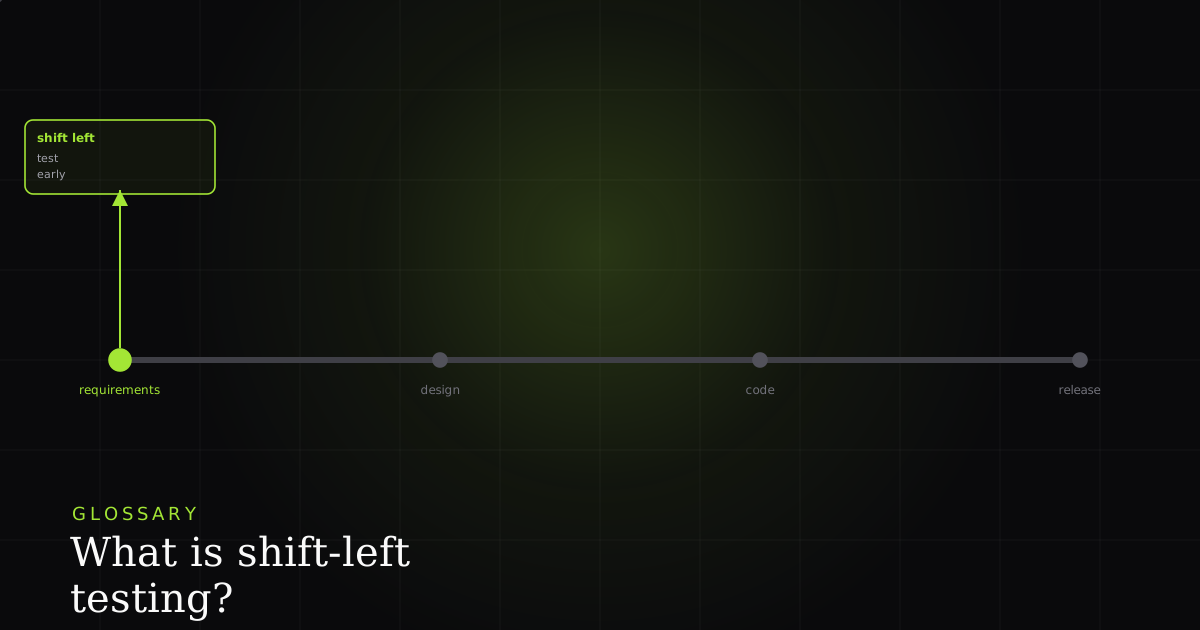
Shift-left testing means moving testing earlier ('to the left') in the software lifecycle, so defects are caught during requirements, design, and coding rather than in a test phase at the end. It is the first half of 'test early and often': the sooner a defect is found, the cheaper it is to fix.
Picture the classic software lifecycle drawn as a timeline running left to right: requirements, design, coding, testing, release. In the old waterfall habit, testing was a phase near the right end: a big verification push after development had finished. Shift-left testing is the deliberate move of that testing activity leftward, into the earlier stages, so quality is checked continuously as the work is created instead of inspected once at the finish line.
The term is not new. It was coined by Larry Smith in 2001, long before 'DevOps' was a word, and it has since become one of the load-bearing ideas behind continuous integration and continuous delivery. The phrase is really a spatial metaphor for an old piece of engineering wisdom (test early and often), with shift-left being the 'test early' half. When testing lives close to the moment code is written, feedback arrives while the author still remembers exactly what they meant.
The economic argument: why earlier is cheaper
The entire case for shifting left rests on one observation: the cost to fix a defect rises the later it is found. A wrong assumption caught in a requirements review is a five-minute conversation. The same assumption caught in a unit test is a quick edit to fresh code. Caught in a staging integration test, it is a debugging session across a couple of components. Caught in production, it is an incident: a hotfix, possibly a rollback, support tickets, and sometimes a reputational cost, all to change code that has since been built upon and shipped to real users.
The mechanism is compounding. Every stage a defect survives, more code, more tests, and more users accumulate around it, so the blast radius of the eventual fix keeps growing. Fixing early is cheap not because early code is special but because nothing depends on it yet. As IBM frames it, shift-left is fundamentally about catching problems while they are still small and local, before they calcify into the expensive, far-reaching kind. That is why 'find defects sooner' is not a nice-to-have. It is the whole return on investment.
What shift-left looks like in practice
Shift-left is not a single tool you install; it is a set of habits distributed across the lifecycle. Concretely, on a team that has shifted left you will see:
- Testers involved in requirements and design reviews. QA reads the spec before a line of code exists, asking 'how would we verify this?' and surfacing ambiguity while it is still cheap to resolve.
- Unit and integration tests written alongside the code. This is where shift-left meets test-driven development: in TDD you write the failing test first, which is shift-left taken to its logical extreme.
- Static analysis and linting in CI. Whole classes of defect (type errors, unsafe patterns, dead code) are caught by machines on every commit, before a human ever runs the program.
- API contract testing. Consumer and provider agree on a contract and each side tests against it, catching integration breakages at build time instead of in a shared environment.
- Acceptance criteria defined up front. Everyone agrees what 'done' means before work starts. See writing acceptance criteria that prevent bugs.
- Tests running continuously in the pipeline. Every push triggers the suite, so a regression is flagged within minutes, not at the end of a sprint.
How it relates to the testing pyramid
Shift-left and the testing pyramid are two views of the same instinct. Martin Fowler's practical test pyramid argues for many fast, cheap unit tests at the base, fewer integration tests in the middle, and only a thin layer of slow, brittle end-to-end tests at the top. Those unit tests are the leftmost, earliest tests you can run: they execute on every save, before anything is deployed. So a well-shaped pyramid is shift-left: it concentrates your testing effort where feedback is fastest and cheapest. If your pyramid is inverted (a fat layer of end-to-end tests and few unit tests), you have effectively shifted right, pushing detection toward the slow, expensive end. (For the full breakdown, see unit vs integration vs end-to-end testing.)
Shift-left is not shift-right: you need both
The counterpart to shift-left is shift-right: testing that happens deliberately in production. Where shift-left prevents defects before release, shift-right catches what only appears under real conditions: real data volumes, real user behaviour, real infrastructure. Its toolkit is monitoring and observability, canary and progressive rollouts, feature flags, and real-user monitoring (RUM). No amount of upstream testing can fully simulate production, so shift-right is where you learn how your software actually behaves in the wild.
The two are complementary, not competing. Shift-left reduces how many defects reach production; shift-right catches the ones that slip through or that only manifest at scale. Treating them as an either/or is the mistake. A mature team squeezes both ends of the timeline, building quality in on the left and verifying it holds on the right.
| Feature | Dimension | Shift-left | Shift-right |
|---|---|---|---|
| When on the timeline | No | Requirements, design, coding | Production / post-release |
| Primary goal | No | Prevent defects early | Catch what only shows at scale |
| Typical techniques | No | Unit + integration tests, static analysis, contract tests, acceptance criteria | Monitoring, canary/progressive rollout, feature flags, RUM |
| Feedback speed | No | Seconds to minutes (in CI) | Hours to days (real usage) |
| What it cannot do alone | No | Simulate real production conditions | Stop defects before users hit them |
Benefits, caveats, and common misconceptions
The benefits are direct: cheaper defects (caught before they compound), faster feedback (minutes in CI instead of days in a test phase), and quality that is built in rather than bolted on at the end. When testing is a continuous property of the work rather than a gate at the finish, the whole delivery pipeline moves faster because it is not repeatedly stalling on late-discovered surprises.
Two misconceptions are worth naming directly. The first is that shift-left means 'developers do all the testing.' It does not. Developers taking on more unit and integration tests is one ingredient, but exploratory testing, test strategy, and automation engineering are still specialist work. The second is that shift-left means 'no QA team needed.' The opposite is true: shift-left moves QA upstream, into requirements and design, where their judgement is most valuable. Per the ISTQB glossary's vocabulary, testing is a lifecycle-spanning discipline; shift-left changes its timing, not its necessity. Read as a staffing cut, shift-left gets the intent exactly backwards.
Where BugMojo fits
Shift-left reduces how many bugs reach users, but it never reaches zero, and the ones that do get through still need fast, faithful reproduction. That is the loop BugMojo closes. When a bug surfaces in early UAT or on staging, the browser extension captures it with its surrounding state (an rrweb session replay, the console output, and the network requests), so the report that flows back to the team is a reproduction, not a vague 'it broke.' A bug captured cleanly in staging is a defect fed back left: fixed before release, exactly where shift-left wants it.
Shift-left cuts how many bugs reach users, but the survivors still need a clean repro. BugMojo captures the failing session (rrweb replay, console, and network) so a staging or UAT bug comes back as a reproduction you can fix and feed back left.
Install the extensionFrequently asked questions
Frequently asked questions
Sources
- Shift-left testing: the term was coined by Larry Smith in 2001 (Wikipedia), Wikipedia (2026)
- What is shift-left testing? Practices, benefits, and pipeline integration, IBM (2026)
- The Practical Test Pyramid: unit, integration, and end-to-end balance, martinfowler.com (2026)
- ISTQB Glossary: standardized definitions of testing terms, ISTQB (International Software Testing Qualifications Board) (2026)
Get bug-tracking insights, weekly.
Engineering deep-dives, QA playbooks, and honest tool comparisons. No spam. Unsubscribe in one click.