

What Is a Vector Database? (Embeddings & Search)
A vector database stores data as high-dimensional numeric vectors (embeddings) and finds items by similarity instead of exact match. Here is how embeddings, nearest-neighbor search, and ANN indexes work, why they power RAG, and when you actually need one.
Definition
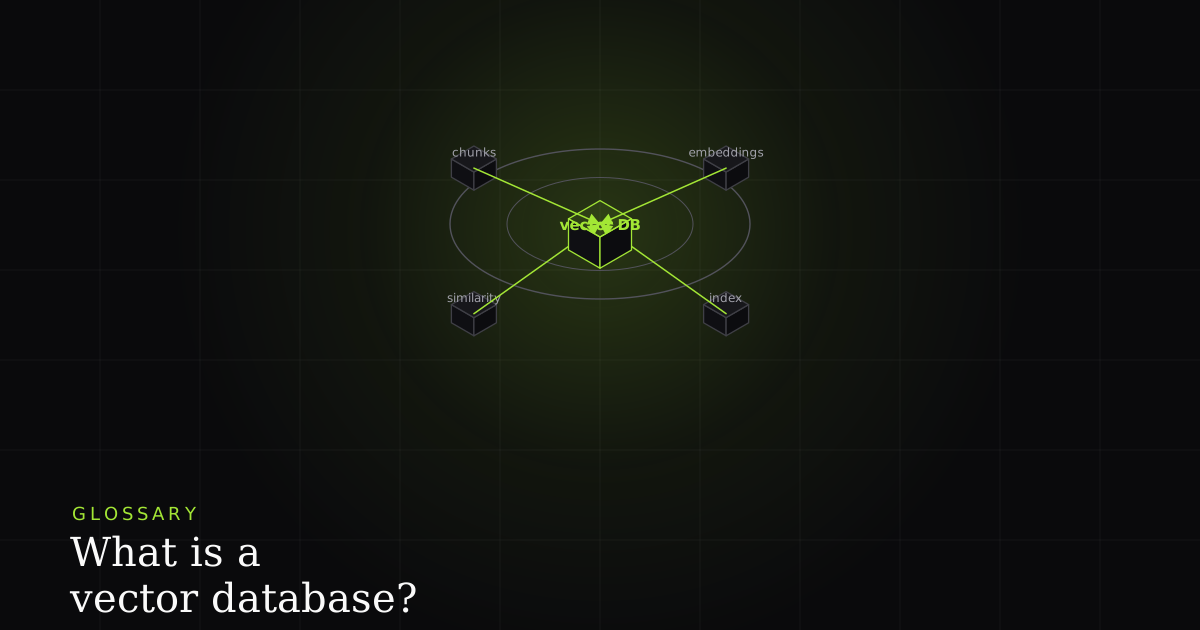
A vector database stores data as embeddings (high-dimensional lists of numbers that capture meaning) and retrieves items by similarity rather than exact match. Its core operation is nearest-neighbor search: given a query vector, find the closest stored vectors, made fast with an approximate index like HNSW. This is what powers semantic search and RAG.
Put plainly: a vector database finds things that mean the same, not things that spell the same. A normal database answers 'find this exact string': it matches literal values and keywords. A vector database answers 'find things that are about the same idea,' so a search for car can surface a document that only ever says automobile, and a question phrased one way can retrieve an answer written a completely different way. That shift, from matching characters to matching meaning, is the entire point, and everything below is just the machinery that makes it possible.
Embeddings: turning meaning into numbers
The trick starts with an embedding. An embedding model takes a piece of content (a sentence, a paragraph, an image) and turns it into a fixed-length list of numbers, often hundreds or thousands of values long. Each of those values is one dimension. The model is trained so that inputs with similar meaning end up near each other in that numeric space, and unrelated inputs end up far apart. So reset my password and I forgot my login produce vectors that sit close together, even though they share almost no words, while chocolate cake recipe lands somewhere else entirely.
You do not read these numbers; you compare them. The embedding is a bridge that converts fuzzy human meaning into coordinates a machine can do arithmetic on. Once your documents are all embedded into the same space, 'related in meaning' becomes 'close together in geometry', a measurable, sortable quantity. That is the quiet superpower of the approach: it reduces the vague notion of relevance to a distance you can compute in microseconds.
Similarity and nearest-neighbor search
How near is near? The usual measure is cosine similarity (roughly, the angle between two vectors) or a related distance metric such as Euclidean or dot-product. High cosine similarity means the two pieces of content point in nearly the same direction in the space, which is the numeric stand-in for 'these mean the same thing.' With a way to measure closeness in hand, the core operation of a vector database falls out naturally: nearest-neighbor search. Given a query vector, return the k closest stored vectors: the top-k most similar items.
Doing that exactly means comparing the query against every vector in the store, which is fine for a thousand items and hopeless for a hundred million. So production systems use an approximate nearest neighbor (ANN) index. An ANN index (HNSW, a navigable small-world graph, and IVF, inverted-file clustering, are the common ones) trades a sliver of accuracy for an enormous speedup, returning almost-always-correct neighbors in a fraction of the time. The index is what lets a vector database stay fast as it grows. Retrieval by meaning at scale is fundamentally an indexing problem, and ANN is the answer.
Why a traditional database can't do this
A relational or keyword database is superb at exactness. WHERE status = 'open' is instant; a full-text index over a literal word is fast and precise. But that machinery has no concept of meaning. It cannot tell you that car and automobile are the same idea, and it cannot answer 'give me the ten documents most semantically similar to this one' without you first inventing the notion of similarity it lacks. You can bolt on synonym lists and stemming, but you are patching a keyword engine, not measuring meaning. A vector database is built for the meaning question from the ground up: it indexes embeddings so nearest-neighbor search stays cheap even over millions of vectors.
The main use case: RAG
The reason vector databases went from niche to everywhere is retrieval-augmented generation (RAG). The pattern is straightforward. Ahead of time, you chunk your documents into passages, embed each chunk, and store the vectors in the database. At query time you embed the user's question into the same space and run nearest-neighbor search to pull back the handful of chunks closest in meaning to the question. You then paste those retrieved chunks into the model's prompt as context, so the large language model answers from your real, current data instead of only its frozen training memory. The original RAG paper formalized exactly this pairing of a neural retriever with a generator.
This is also the honest antidote to hallucination. A model with no grounding will confidently invent an answer; a model handed the three most relevant passages from your knowledge base has real material to quote and cite. Retrieval does not make hallucination impossible, but it sharply reduces it by replacing 'guess from memory' with 'answer from these documents.' It is the same instinct behind giving an AI agent tools instead of expecting it to know everything up front.
Other uses and key concepts
RAG is the headline, but the same nearest-neighbor primitive powers plenty more: semantic search over docs and support tickets, recommendations ('items like this one'), deduplication (near-identical records cluster tightly), and anomaly detection (outliers sit far from every cluster). A few terms you will meet along the way: dimensions (the length of each vector), the index itself (HNSW or IVF), metadata filtering (restrict the search to vectors tagged, say, lang:en or a specific tenant), and hybrid search (blend classic keyword ranking with vector similarity so you get both exact-term precision and semantic recall).
On the tooling side, the space has real choice. Dedicated engines like Pinecone, Weaviate, Milvus, and Qdrant are built purely for vectors at scale, while pgvector adds vector columns and ANN indexes to the Postgres you may already run. They differ in scaling model, indexing options, and how tightly they integrate with the rest of your data, but they all implement the same core loop: embed, index, search by similarity.
Honest caveats
The second caveat is architectural: you often do not need a dedicated vector database at all. For a small or medium corpus, pgvector inside your existing Postgres keeps your vectors next to your relational data with one system to run, back up, and secure. Reach for a standalone vector store when you genuinely hit its limits: very large corpora, high query throughput, or a need for advanced indexing, filtering, and horizontal scale. Adopt the specialized system when the workload demands it, not because the architecture diagram looks more impressive with a new box on it.
That grounding principle is the same one that makes an AI coding agent useful. Handing a model a real, retrieved bug reproduction (the actual session, console, and network state behind a failure) is the debugging version of RAG: you replace 'guess from the stack trace' with 'answer from the captured context.' BugMojo exists to give the agent that real context, so it reasons from what actually happened instead of what it might imagine.
BugMojo captures the failing session (rrweb replay, console, and network) and hands the whole bundle to Claude Code or Cursor over MCP, so your agent reasons from what actually happened, the same way RAG grounds a model in retrieved facts.
Install the extensionFrequently asked questions
Frequently asked questions
Sources
- What is a Vector Database? The definitive learn-hub explainer, Pinecone (2026)
- What are Vector Databases? A cloud provider overview of embeddings and similarity search, AWS (2026)
- Vector database: encyclopedia entry on approximate nearest neighbor and indexing, Wikipedia (2026)
- Retrieval-Augmented Generation for Knowledge-Intensive NLP Tasks: RAG grounds an LLM with vector retrieval, Lewis et al. / arXiv (2020)
Get bug-tracking insights, weekly.
Engineering deep-dives, QA playbooks, and honest tool comparisons. No spam. Unsubscribe in one click.