

What Is Technical Debt? Causes, Types, and How to Manage It
Technical debt is the implied future cost of choosing an easier, faster solution now instead of a better one that takes longer. Like financial debt, it accrues interest, slowing every future change until you pay it down. Here is where it comes from and how to manage it.
Definition
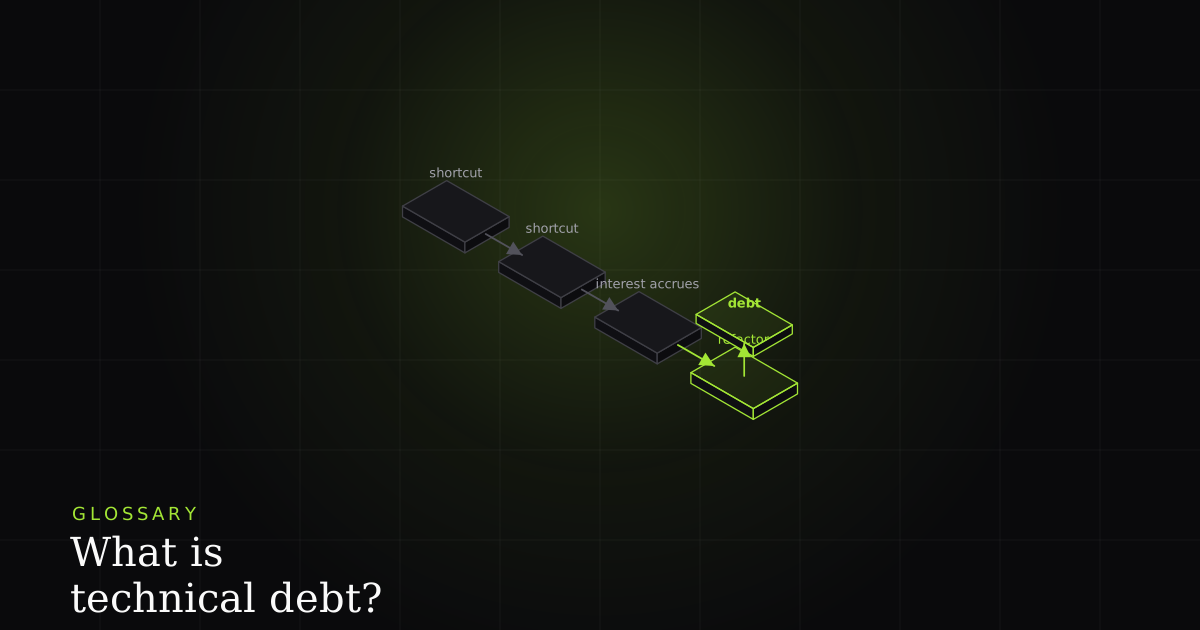
Technical debt is the implied future cost of choosing an easier, faster solution now instead of a better one that would take longer to build. Like a financial loan it accrues interest: every future change grows more expensive until you refactor and repay the principal.
The metaphor comes from Ward Cunningham, who coined it to explain refactoring to a non-technical stakeholder. His point was subtle and often lost: he was not saying 'writing bad code is like debt.' He was saying that shipping code which reflects your current, incomplete understanding of a problem is like borrowing money: it lets you get to market and learn faster. The debt is the gap between what you shipped and what you now know the design should be. You go into debt on purpose, and you repay it by refactoring as your understanding improves. Left unpaid, 'every minute spent on not-quite-right code counts as interest on that debt.'
Martin Fowler sharpened the framing for everyday use. Debt lets a team ship sooner, but they pay for it in slower future delivery, because the cruft in the codebase acts as interest on the loan. The strategic question is never 'do we have debt' (every real system does) but 'is the interest we are paying worth the speed we borrowed for.' That reframes messy code from a moral failing into a financial decision, which is exactly the point: some debt is a smart investment, and some is a payday loan you will regret.
The technical debt quadrant: not all debt is equal
The most useful model for reasoning about debt is Fowler's technical debt quadrant. It splits debt along two independent axes. The first is deliberate versus inadvertent: did you take on the debt knowingly, or did you only discover it later? The second is prudent versus reckless: was the trade-off thoughtful, or careless? Crossing them gives four kinds of debt, and they demand very different responses.
| Feature | What it sounds like | Verdict |
|---|---|---|
| Deliberate + Prudent | "We must ship now and will deal with the consequences." A real trade-off you record and plan to repay. | Legitimate: borrow to invest. |
| Deliberate + Reckless | "We don't have time for design." You know the cost and take the shortcut anyway. | Dangerous: a payday loan. |
| Inadvertent + Prudent | "Now we know how we should have done it." Debt from learning a better pattern only after shipping. | Normal: repay as you learn. |
| Inadvertent + Reckless | "What's layering?" Debt from not knowing the better way even existed. | Dangerous, and invisible. |
The headline is that deliberate, prudent debt is a legitimate engineering decision, not a failure. Shipping a simpler design to hit a launch window, validate an idea, or learn from real users is borrowing to invest, as long as you record the debt and plan to repay it. The dangerous quadrants are reckless debt, where a team skips design it knows it needs, and inadvertent debt, where the team does not even realize it is accumulating a cost. Most real debt is inadvertent-and-prudent: you built the best thing you knew how to build, and only afterward did you understand the better shape. That is not carelessness; it is how software learning works.
Where technical debt comes from
Debt rarely arrives in one big decision. It accumulates from a hundred small ones. The common sources are familiar to anyone who has shipped software: rushed deadlines that force shortcuts; skipped or shallow test coverage; copy-paste duplication in place of a shared abstraction; dependencies left un-upgraded until the upgrade is a project of its own; unclear or shifting requirements that leave code modeling a problem that no longer exists; and the evergreen 'we'll refactor later' that never gets scheduled.
Two sources are easy to miss because they are not about code at all. The first is missing documentation and lost context: when the engineer who understood a subsystem leaves, the knowledge gap behaves exactly like debt, and every future change to that area now costs extra to reconstruct what it does. The second is unclear requirements: code written against a fuzzy spec encodes the fuzziness, and paying that down later means untangling assumptions nobody wrote down. Both are why debt is a systems problem, not just a 'write cleaner code' problem.
How debt connects to bugs and quality
This is the part that matters most for a bug-tracking platform, and it is the least discussed. High technical debt does not just slow feature work. It directly produces more bugs, and worse bugs. Fragile, tangled code fails in surprising ways: a change in one place breaks something three modules away, because the coupling that debt represents is exactly the hidden path a defect travels. Under-tested code has no safety net to catch the break, so it ships. Duplicated logic means a fix in one copy leaves the others broken. The result is a codebase where every change has a wide, unpredictable blast radius.
That blast radius shows up in two specific quality symptoms. The first is regressions: things that used to work and break after a change. Debt-heavy code regresses more, because its dependencies are implicit and its baseline behavior is poorly pinned by tests. The second is hard-to-reproduce bugs: when behavior depends on tangled state and undocumented assumptions, defects surface only under specific, hard-to-recreate conditions. If you want to see debt on a dashboard rather than feel it in code review, watch your QA metrics. A rising regression rate and a growing pile of 'cannot reproduce' bugs clustered in the same modules is technical debt made visible.
How to manage technical debt
Make it visible. Debt you cannot see always loses to debt you can, meaning features win every prioritization call because the debt is invisible. Track debt as real work items in the same backlog as features and bugs, with a concrete description of the interest it charges. Once it is a ticket, it can be argued for, estimated, and scheduled like anything else.
Pay it down incrementally. Big-bang rewrites are themselves a form of reckless debt: they are risky, they stop feature work, and they often recreate the original mess. Prefer the boy-scout rule: leave the code a little cleaner than you found it. Small refactors that ride along with the changes you are already making compound in your favor, the same way the debt compounded against you. The area you are touching this sprint is the area worth cleaning this sprint.
Allocate capacity, and choose your battles. Reserve a standing slice of each cycle (many teams use 15 to 20%) so repayment is routine rather than a special-occasion fight. Then be ruthless about which debt to repay. Debt in a stable corner nobody touches may never charge enough interest to be worth fixing; leave it. Debt in a hot, frequently-changed module compounds fast and should be paid first. Prioritize by how often the code changes, not by how ugly it looks. That single rule separates debt worth paying from debt worth living with.
How debt shows up in BugMojo
You do not usually see technical debt directly. You see its symptoms. In practice, debt shows up as recurring, hard-to-reproduce bugs clustered in the same areas of the product: the checkout flow that breaks a different way every release, the settings page nobody wants to touch, the report that fails only for certain accounts. Those hotspots are debt announcing itself through defects.
BugMojo makes those hotspots visible by capturing a real reproduction for each report: an rrweb session replay, the console output, and the network requests behind the failure. When the same fragile module keeps generating captures, the pattern is unmistakable, and the 'cannot reproduce' bug becomes reproducible. That turns a vague feeling that 'this part of the app is always broken' into evidence you can bring to a prioritization meeting, which is exactly what you need to argue for paying the debt down.
BugMojo captures a real reproduction (rrweb replay, console, and network) for every bug, so the fragile, debt-heavy areas of your product stop hiding behind 'cannot reproduce' and become a clear case for paying the debt down.
Install the extensionFrequently asked questions
Frequently asked questions
Sources
- Technical Debt: Martin Fowler on the debt metaphor and when it is worth taking on, martinfowler.com (2026)
- Technical debt: overview, causes, types, and measurement, Wikipedia (2026)
- Technical Debt Quadrant: deliberate/inadvertent × prudent/reckless, martinfowler.com (2026)
- Ward Explains Debt Metaphor: Ward Cunningham on the original meaning, c2 wiki (Ward Cunningham) (2026)
Get bug-tracking insights, weekly.
Engineering deep-dives, QA playbooks, and honest tool comparisons. No spam. Unsubscribe in one click.