

BugMojo vs LogRocket: Session Replay for Debugging, Compared (2026)
Both record sessions, but they solve different problems. BugMojo is zero-setup bug capture for developers and QA with an MCP server for AI agents; LogRocket is production-scale replay plus product analytics. Here is the honest line between them.
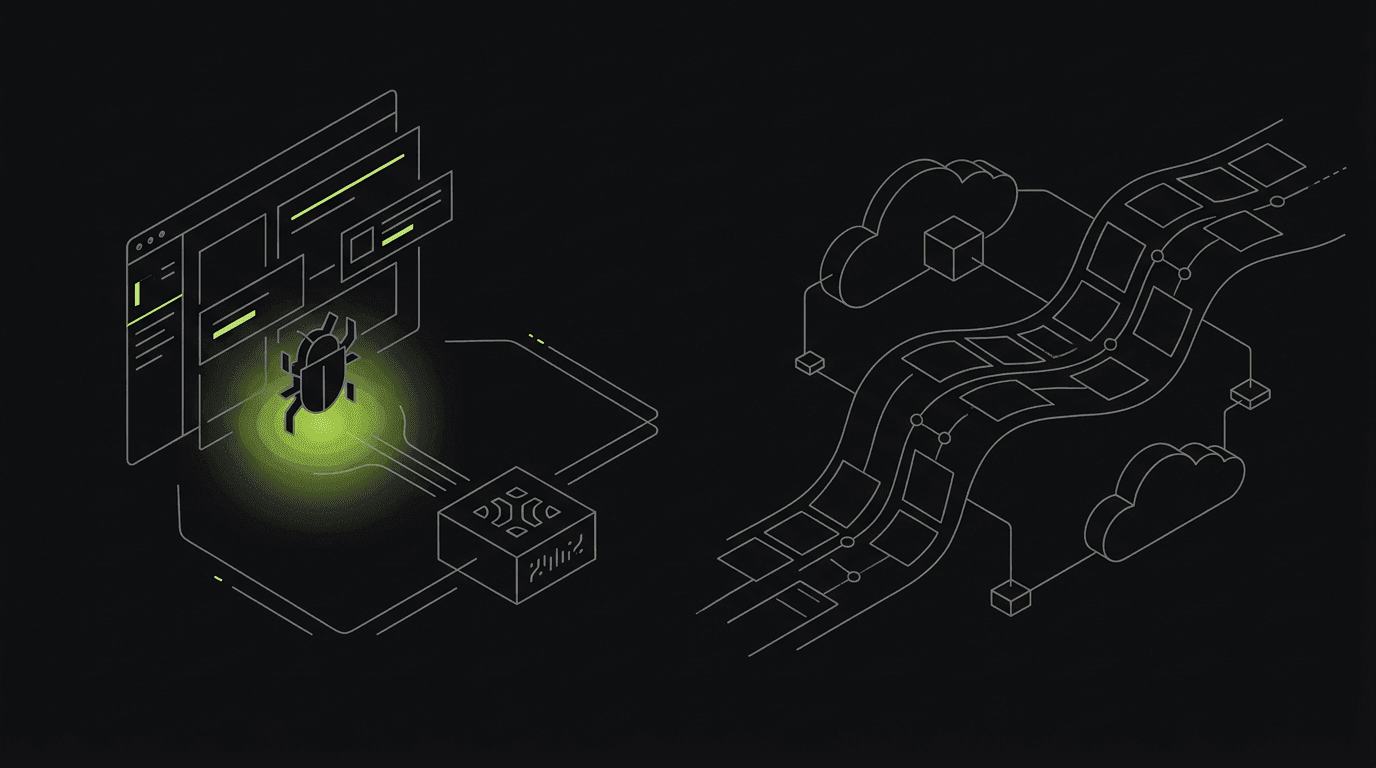
If you only read the feature lists, BugMojo and LogRocket look like rivals: both record what happened in the browser and play it back. But they sit at opposite ends of the debugging loop. LogRocket is always-on, instrumented in your shipped app, and built to tell you what thousands of real users did. BugMojo is on-demand, triggered by a human who just hit a bug, and built to hand one complete reproduction to an AI coding agent. One is a telescope pointed at your whole user base; the other is a tweezers for the single bug in front of you.
This comparison draws that line first, then puts real 2026 pricing next to it, and then covers the dimension that actually decides the choice in the AI-agent era: both tools now ship an MCP server, so the question is no longer whether an agent can read your data but what data it gets to read. We will be scrupulously two-sided. LogRocket wins outright on production scale, analytics, and funnels, and we mark BugMojo honestly worse where it is.
BugMojo vs LogRocket in one paragraph
BugMojo is a bug-capture-first tool: a browser extension records an rrweb replay plus console logs, network requests, and a screenshot the moment you hit a bug, then an MCP server hands that report to AI coding agents. LogRocket is a production-scale observability and product-analytics platform that always-on records real user sessions through an installed SDK, adding heatmaps, funnels, and cohort analysis. One reproduces a bug fast; the other explains aggregate behavior at scale.
The cleanest way to keep these straight: ask who pulls the trigger. With LogRocket, the trigger is automatic. Once its SDK is live, it samples and records real sessions whether or not anyone is watching, which is exactly what you want for production monitoring. With BugMojo, the trigger is a person, a developer, a tester, a support engineer, a PM, who hits a bug and clicks capture. That single difference cascades into everything else: setup model, pricing meter, retention, and what an AI agent can ultimately read.
The dimension that decides it: what the MCP can see
Both BugMojo and LogRocket now ship MCP servers, so AI-agent access is not the differentiator. What matters is the data source. LogRocket's MCP reads sessions its SDK already captured in production, so instrumentation is a prerequisite. BugMojo's MCP exposes a bug captured by a zero-install browser extension, so an agent receives a complete reproduction for an app that was never instrumented. Same protocol, different source.
Most "LogRocket alternatives" pages written before mid-2026 claim no rival has an MCP server. That is now false. LogRocket shipped a hosted MCP at mcp.logrocket.com/mcp on June 2, 2026, wired to its Galileo AI, letting Claude Code, Cursor, Codex, and VS Code query sessions, metrics, and issues. So the honest framing is not who has MCP but what the MCP can read. LogRocket's can only surface sessions the SDK already collected, which means a teammate had to ship instrumentation and the bug had to occur in production traffic the platform happened to sample. BugMojo's MCP exposes a bug a human captured deliberately, including the rrweb replay, console, network, and screenshot, for an app with zero instrumentation. An agent gets a fully reproduced bug without anyone touching the codebase first. That is the wedge, and it is the row no competitor can claim.
| Feature | BugMojo | LogRocket |
|---|---|---|
| Ships an MCP server for AI agents | ✓ | ✓ |
| What the agent reads | One human-captured reproduction (replay + console + network + screenshot) | Real-user sessions + metrics already collected |
| Needs an SDK shipped in your app | No | ✓ |
| Zero-setup Quick Capture (no project config) | ✓ | No |
| Always-on production recording at scale | No | ✓ |
| Product analytics: funnels, heatmaps, cohorts | No | ✓ |
| Session-replay engine | rrweb (open-source, ~19.8k stars) | Proprietary |
| Pricing meter | Per developer / capture | Per session volume |
Where BugMojo wins
Zero setup. BugMojo captures through a browser extension, so there is nothing to add to your application's source, no deploy, and no build step. A new teammate installs the extension and captures a bug in under a minute. LogRocket cannot record anything until its SDK is installed, configured, and shipped, which is a real engineering task gated behind a release cycle.
Pre-release and staging bugs. Because capture is human-triggered and SDK-free, BugMojo works on localhost, staging, a preview deploy, or a half-built feature branch. A QA tester reproduces a layout break before it ever ships, and an AI agent reads the replay. LogRocket is built around production traffic; it is not the tool for catching the bug that never reaches real users.
Agent-ready reproductions. BugMojo records with rrweb, the open-source replay engine carrying ~19.8k GitHub stars and embedded by Sentry, PostHog, and Datadog. rrweb captures a DOM snapshot plus mutation diffs that replay as real, DevTools-inspectable DOM rather than video, so a five-minute session compresses to roughly 100-500KB. That structured, inspectable artifact, paired with console and network, is exactly what an AI agent can parse and act on, not a screen recording it has to guess about.
It replaces the vague Jira ticket. The everyday win is mundane and large: instead of "checkout looks broken on mobile, idk," a teammate hands over a one-click replay plus console and network that Claude Code or Cursor can read and draft a fix against, no re-tracing required.
Where LogRocket wins
Be honest: for a large set of jobs, LogRocket is simply the better tool, and BugMojo does not try to compete.
Production scale. LogRocket's SDK runs in your shipped app and records real user sessions continuously. It surfaces errors and performance regressions across your actual traffic and shows you bugs you did not know to look for. A human-triggered capture tool, by definition, only sees the bugs someone noticed and chose to record.
Product analytics. Heatmaps, funnels, conversion analysis, and cohort retention are core LogRocket features. If you need to know where users drop off in a flow or which UI elements get rage-clicked across thousands of sessions, that is aggregate analysis BugMojo does not do at all.
Track record and depth. LogRocket holds a 4.6/5 rating across 2,348 verified G2 reviews, with reviewers consistently citing session replay, frontend performance monitoring, and product analytics as core strengths. That is a mature, broad platform with years of refinement behind it. BugMojo is deliberately narrow: it captures one bug well and hands it to an agent. For passive, population-scale observability, LogRocket wins outright.
Which should you choose
Choose BugMojo if your pain is the gap between finding a bug and getting it fixed. You want a developer, tester, or non-technical teammate to capture a complete, reproducible report in one click, no SDK, no project setup, and you want an AI agent to read that report and start on a fix. You care about pre-release and staging bugs, fast turnaround on individual issues, and per-developer pricing rather than paying by session volume for analytics you will not use.
Choose LogRocket if your pain is understanding your live product. You need always-on recording of real users, error and performance monitoring across production traffic, and product analytics like funnels and heatmaps to see how your whole user base behaves. You have the engineering capacity to install and maintain an SDK, and the budget for the Professional tier where the analytics and MCP actually unlock.
Run both if the budget allows, because they cover different stages. BugMojo catches and packages the bug a human reproduces, often before release; LogRocket watches the real users and aggregate behavior in production. The shared thread in 2026 is MCP: each can hand its slice of context to the same agent. The difference, again, is the source, one curated reproduction versus sampled production sessions.
Install the free BugMojo extension, capture an rrweb replay plus console and network in one click, and hand the reproduction to Claude Code or Cursor over MCP. No SDK, no project setup, no session-volume pricing.
Install the extensionFrequently asked questions
Frequently asked questions
Sources
- LogRocket official pricing: Free tier = 1,000 sessions/mo, 3 seats, 1-month retention; Core from $69/mo (10k sessions); Professional from $295/mo (annual) unlocks heatmaps, funnels, product analytics, AI, and MCP, LogRocket (2026)
- LogRocket MCP server docs: hosted at mcp.logrocket.com/mcp, lets Cursor, Claude Code, Codex, and VS Code query existing LogRocket sessions, metrics, and issues via the LogRocket API, LogRocket Docs (2026)
- Introducing the LogRocket MCP launch post (June 2, 2026): MCP connects to Galileo AI so existing LogRocket customers' agents can pull session replays already collected by the SDK, LogRocket Blog (2026-06-02)
- rrweb (the open-source DOM session-replay engine BugMojo records with): ~19.8k GitHub stars; embedded by Sentry, PostHog, Datadog, Mixpanel, and New Relic, rrweb / GitHub (2026)
- LogRocket on G2: 4.6/5 stars across 2,348 verified reviews, reflecting strength in session replay, performance monitoring, and product analytics, G2 (2026)
- rrweb DOM recording explained: full DOM snapshot plus serialized mutation diffs replay as real, DevTools-inspectable DOM (not video), so a 5-minute session compresses to ~100-500KB, rrweb Guide / GitHub (2026)
Get bug-tracking insights, weekly.
Engineering deep-dives, QA playbooks, and honest tool comparisons. No spam. Unsubscribe in one click.