

How AI agents work with BugMojo
Understand the full loop, from a captured bug to an agent-proposed fix that a human verifies and closes.
BugMojo captures a bug once, in high fidelity, and then makes that evidence readable by both people and AI coding agents. Because an agent can read the same session replay, logs, and repro steps a developer would, it can go from a bug report to a proposed fix without a human re-explaining what went wrong. This page walks through that loop end to end.
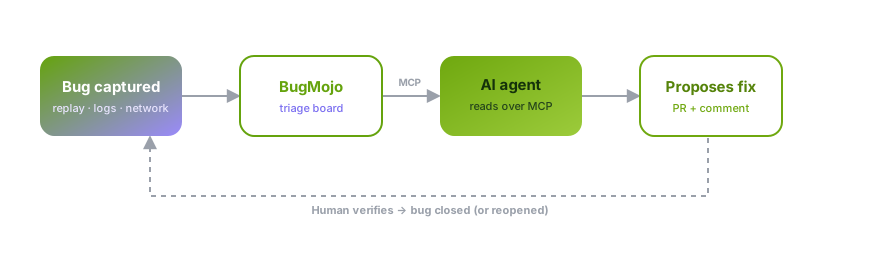
The end-to-end loop
From capture to closed
Capture. Someone hits a bug and grabs it with the extension. BugMojo records the rrweb session replay, console logs, network requests, a screenshot, and device metadata, with PII redacted in the browser first.
Assign. On the bug detail page you set the Assignee to an AGENT instead of a teammate, using the same control.
Read. The connected agent uses MCP to pull the bug's replay context, console and network logs, and repro steps directly into its working session.
Fix. With the failure made concrete, the agent proposes a code change or opens a pull request through an integration like GitHub.
Verify and close. A human reviews the change, confirms the bug is gone, moves it through DEV_TESTING and QA_TESTING, and marks it CLOSED.
Why this is a first
Most bug trackers store a title, a description, and maybe a screenshot: evidence a human has to interpret and an agent cannot really use. BugMojo captures the actual failure: a reconstructed DOM replay, the console errors, and the network calls, all structured. That structure is what lets an AI agent read a bug the way a developer does, instead of guessing from a sentence. The Model Context Protocol is the bridge that carries that evidence into the agent's tools.
The human stays in the loop
An agent proposes and can ship, but a person decides. You review every change, and access is scoped: an agent only reads what you allow it to. Nothing is closed automatically. This keeps speed on the agent's side and judgment on yours.
Common questions
Does the agent fix bugs on its own?
No. The agent reads the bug's evidence and proposes a fix, but a human reviews the change and decides whether to ship it and close the bug. You stay in control.
What does the agent actually see?
Over MCP the agent reads the bug's session replay context, console logs, network requests, and repro steps: the same evidence a developer sees on the bug detail page.
Which agents can connect to BugMojo?
Any MCP-compatible coding agent, including Claude Code, Cursor, VS Code, and Windsurf. They connect to the @bugmojo/mcp-server over the Model Context Protocol.
Related articles
- Set up the MCP server in Claude CodeConnect Claude Code to BugMojo over MCP so it can read a bug's replay context, logs, and repro steps and start fixing.
- Agent access, tokens, and the security modelUnderstand how an AI agent's access is scoped, what it inherits from you, and the guardrails that keep it in bounds.
- MCP tool referenceKnow exactly which tools a connected AI agent can call over MCP to read a BugMojo bug and act on it.
- Assign bugs to teammates or to AI agentsRoute any bug to the right owner (a teammate or an AI coding agent) from the same assignee control.