

What Is a Hotfix? When to Use One and How to Ship It Safely
A hotfix is an urgent, narrow fix shipped straight to a live system, outside the normal release. Here is when it is justified, how to branch it, and how to ship it without making the outage worse.
 Hrishikesh Baidya5 min read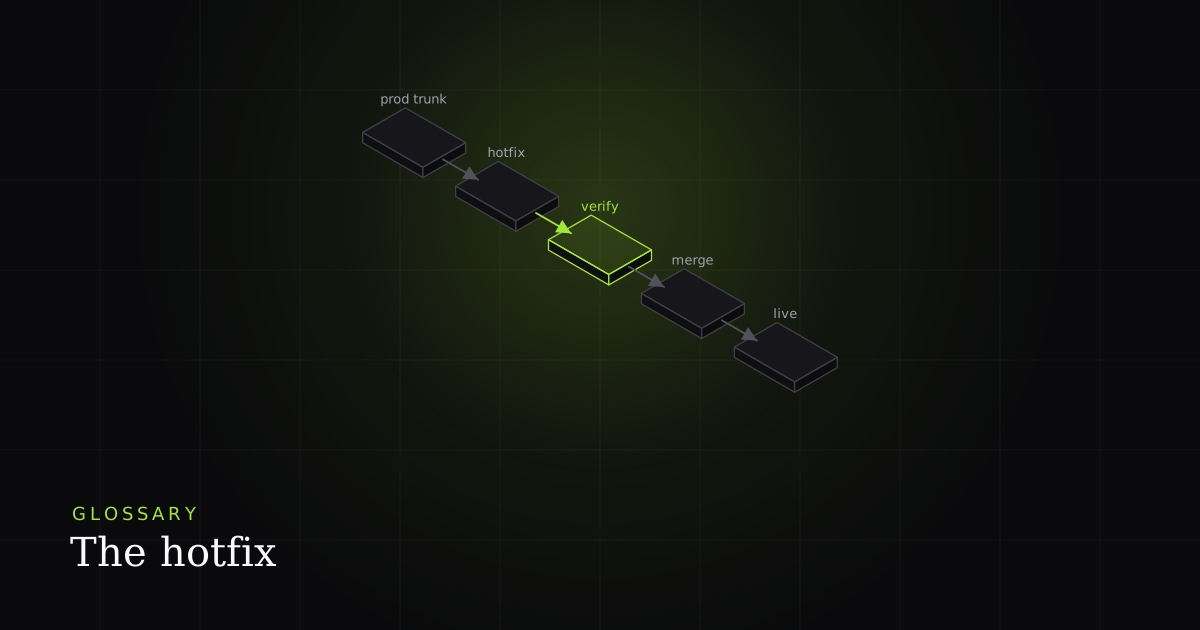
Definition
A hotfix is an urgent, narrowly scoped code change applied directly to a live production system to fix a critical defect, outside the normal release schedule. It trades the full testing of a routine patch for speed, so it should be the smallest diff that stops the failure and nothing more.
The defining trait is in the name. TechTarget defines a hotfix as a repair 'applied to a hot, or live, system' and taken 'outside the normal DevOps workflow' — historically also called quick-fix engineering (QFE). That out-of-band, live-system nature is exactly what separates a hotfix from a routine patch or a scheduled release. A patch waits its turn; a hotfix jumps the queue because something on production is actively broken.
Why it matters
The hotfix is not a niche term — it is baked into the industry-standard metric for delivery stability. DORA defines Change Fail Rate as the share of deployments that 'require immediate intervention... likely resulting in a rollback of the changes or a "hotfix" to quickly remediate any issues.' So when you ship a hotfix, you are by definition logging a failed change, and your Failed Deployment Recovery Time clock — how fast you recover from a deployment that needs intervention — is running. The word maps to a number your leadership already tracks.
That number is moving in the wrong direction industry-wide, which raises the stakes on getting hotfixes right. In the 2024 DORA State of DevOps report, the high-performing cluster shrank from 31% of respondents to 22% while the low cluster grew from 17% to 25%, and for the first time the medium cluster posted a lower change failure rate than the high cluster. The lesson buried in those numbers: throughput and stability move independently. Shipping fast without a disciplined hotfix-and-recovery practice is exactly how teams slide down a tier.
The mechanics are where teams quietly lose. The canonical Git Flow model spells out one rule for the hotfix branch: it is 'created from master' (production), it is named hotfix-*, and it 'must merge back into both develop and master.' The branch-from-production part keeps the diff minimal — you carry only what is live plus your fix. The merge-into-both part is the step teams skip under pressure, and skipping it is precisely how a fixed bug regresses on the very next release, because develop never received the patch.

Speed is the whole point of a hotfix, and also its biggest liability. The 2024 CrowdStrike outage is the textbook case. On 19 July 2024 a Falcon 'Channel File 291' content update 'passed validation due to a bug in CrowdStrike's content verification software' and crashed an estimated 8.5 million Windows devices — Microsoft's figure, under 1% of all Windows machines, yet enough to ground flights and halt hospitals. CrowdStrike's published RCA committed to mitigations so 'the Channel File 291 scenario is now incapable of recurring.' The takeaway for any urgent ship: a change that skips adequate validation can cause a far larger incident than the bug it was meant to fix.
How this shows up in a real BugMojo bug report
Most hotfix articles stop at 'create a hotfix branch and test it.' The harder, earlier problem is scoping: a hotfix is a triage decision before it is a branch, and the decision needs reproduction state, not a guess. You cannot write the narrowest correct diff if all you have is a stack trace pointing at a line. The trace tells you where it threw; it does not tell you the props, the API response, or the user action that produced the bad value. Guess wrong and you ship a hotfix that patches a symptom and regresses next release.
This is where the capture matters. In a BugMojo report the failure does not arrive as a bare trace — the browser extension captures it with its surrounding context: an rrweb session replay, the console output, the network requests, and a screenshot. So the frame at Checkout.tsx:88 sits next to the exact POST /api/cart response that returned an empty cart, and the replay shows the click that triggered it. Then the BugMojo MCP server hands that whole bundle to an AI coding agent — Claude Code or Cursor. The agent reads the failure and the state behind it, which is the difference between 'patch line 88' and 'guard the unguarded cart.items[0] access on line 88 that this replay proves is the cause' — and a flag to backport the change into develop so it does not regress.
| Feature | Capability | BugMojo | Prod error monitor (Sentry/BugSnag) |
|---|---|---|---|
| Reproduction state (replay + console + network) to scope the diff | — | Yes | Breadcrumbs only |
| Failure bundle handed to an AI agent over MCP to scope the hotfix | — | Yes | No |
| Flags the backport into develop so the fix does not regress | — | Agent-assisted | No |
| Aggregate uncaught exceptions across a production fleet | — | No | Yes |
| Alert when a deployed hotfix raises the live error rate | — | No | Yes |
| Mature production error monitoring at scale | — | No | Yes |
Frequently asked questions
Frequently asked questions
Sources
- A successful Git branching model — hotfix branches are created from master, named hotfix-*, and must merge back into both develop and master — Vincent Driessen (nvie.com) (2024)
- DORA's software delivery metrics: the four keys — Change Fail Rate and Failed Deployment Recovery Time name rollback and hotfix as the recovery paths — DORA / Google Cloud (2024)
- What is a hotfix? — an urgent change applied to a hot, or live, system, outside the normal DevOps workflow (a.k.a. QFE) — TechTarget (2022)
- 2024 CrowdStrike-related IT outages — a faulty Falcon Channel File 291 update passed validation due to a content-checker bug and crashed an estimated 8.5 million Windows devices — Wikipedia (citing Microsoft, CrowdStrike RCA) (2024)
- Channel File 291 Incident RCA is Available — CrowdStrike's root-cause announcement and committed mitigations — CrowdStrike (2024-08-06)
- Highlights from the 2024 DORA State of DevOps Report — the high-performing cluster shrank from 31% to 22% while the low cluster grew from 17% to 25% — DX (getdx.com) (2024-10-29)
Get bug-tracking insights, weekly.
Engineering deep-dives, QA playbooks, and honest tool comparisons. No spam — unsubscribe in one click.