

Chrome DevTools for Bug Reports: The 8 Panels That Matter
Eight Chrome DevTools panels cover almost every bug report. Here is what to grab from Console, Network, Elements, Sources, Performance, Application, Rendering, and Lighthouse, and how to stop hand-assembling them.
 Manvi7 min read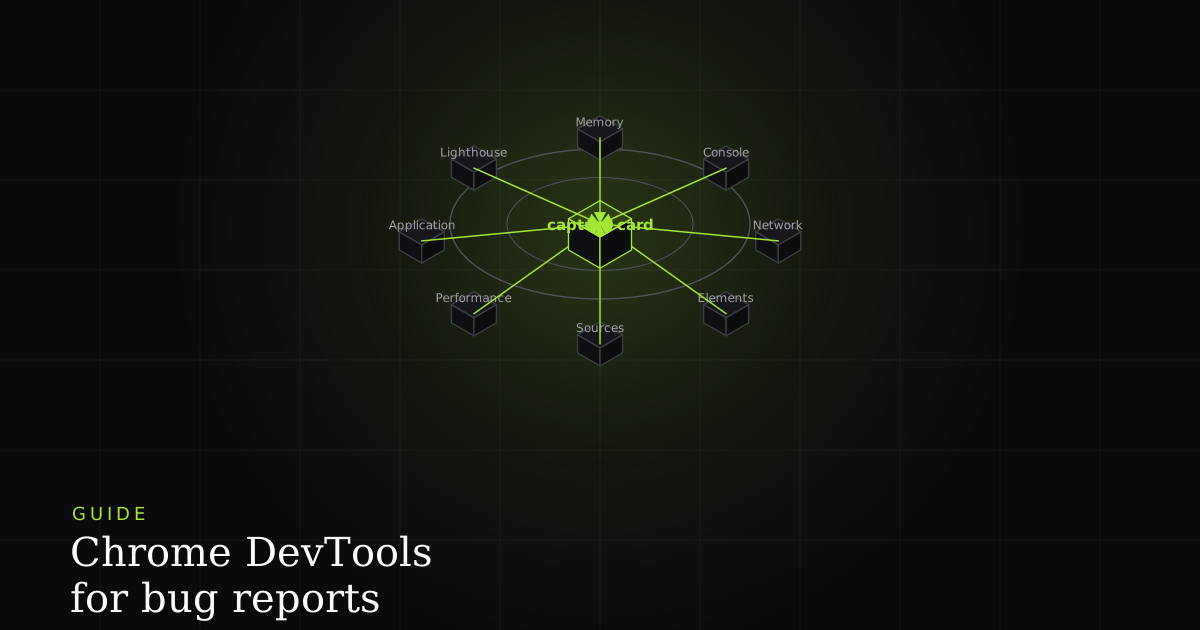
Most bug reports fail in the same place: the reporter saw something break, but the evidence that would locate the fault is already gone. The console scrolled away. The Network panel was not open when the request fired. Nobody enabled Preserve log, so the redirect wiped the entry.
Chrome DevTools holds everything a developer needs to fix that bug. The skill is knowing which of its panels answers which question, and what artifact to pull from each. This is a field guide to the eight that matter, what to grab from each, and where the manual approach quietly fails.
Which DevTools panels matter for a bug report?
Eight panels cover almost every report. Console captures errors and logs. Network shows the failing request and its status code. Elements holds the rendered DOM and CSS. Sources sets breakpoints. Performance records Core Web Vitals. Application inspects storage. Rendering surfaces paint overlays. Lighthouse runs a quick audit. Grab the two or three that match the symptom.
The trap is treating DevTools as one tool. It is a workbench of specialised panels, and a good report uses the smallest set that explains the bug. A blank screen is a Console question. A failed save is a Network question. A misaligned button is an Elements question. Match the panel to the symptom and you collect signal instead of noise.
The 8 panels and what to grab
1. Console — the error and the REPL
Google documents the Console as a tool to test and debug JavaScript web applications, with two main uses: viewing logged messages and running JavaScript as a REPL against the inspected page. For a bug report, grab the red error and its full stack trace, expand it, and copy the top frame. That single line usually names the file and function that threw. Use the REPL to confirm state, for example typing a variable name to check whether the data the UI expected actually arrived.
2. Network — the failing request and the HAR
The Network panel is the HTTP layer: every request, its status code, payload, timing, and initiator. To attach it to a bug, enable Preserve log first — Google notes DevTools then saves all requests until you disable it, so entries survive reloads and redirects. Reproduce, then right-click and choose Save all as HAR (sanitized) to export the whole session as a standard JSON file, or Copy as cURL / Copy as fetch to hand a developer a single replayable request.
# Right-click the failing request in the Network panel →
# Copy → Copy as cURL, then paste to reproduce server-side:
curl 'https://api.example.com/v1/checkout' \
  -X POST \
  -H 'content-type: application/json' \
  -H 'authorization: Bearer <redacted>' \
  --data-raw '{"cartId":"c_4821","coupon":"SUMMER"}'
# → 500 Internal Server Error reproduces outside the browser.
3. Elements — the rendered DOM and CSS
The Elements panel inspects and edits the live DOM and CSS. For layout and styling bugs, the value is in two sub-panes Google highlights: the Computed tab lists the resolved properties Chrome actually rendered (not what the stylesheet asked for), and the Event Listeners pane traces a listener back to its source. Screenshot the broken node with its Computed values, and you have answered why is this element 4px off before the developer opens the file.
4. Sources — breakpoints and the failing line
Sources is where you stop guessing. Set a breakpoint on the line the Console stack trace named, reproduce, and step through to watch the values diverge from what you expected. For a report, you usually do not attach Sources output directly — you use it to turn it breaks sometimes into a precise condition: it throws when cartId is null on the second render. That sentence is worth more than ten screenshots.
5. Performance — Core Web Vitals and CPU profiles
The Performance panel now opens straight into Live Metrics. Google's docs state it immediately captures and shows your local Largest Contentful Paint (LCP) and Cumulative Layout Shift (CLS), and captures Interaction to Next Paint (INP) once you interact with the page — a complete Core Web Vitals snapshot without a separate run. For a slow-page bug, record a trace of the interaction and attach the flame chart; the long task that blocked the main thread is usually visible at a glance.
6. Application — storage and service workers
State bugs that survive a reload live here. The Application panel inspects and edits Local Storage and Session Storage key-value pairs, IndexedDB object stores, Cache Storage, service workers, and the web app manifest. When a user reports I logged out but the app still thinks I am signed in, the answer is a stale token in storage or a service worker serving a cached response. Grab the relevant keys and their values.
7. Rendering — paint and layout-shift overlays
The Rendering tab (open it from the Command Menu) turns invisible problems visible. Toggle Paint flashing to see what repaints on every frame, or Layout Shift Regions to catch the element that jumps and tanks CLS. For a janky-scroll or content-jump report, a short screen recording with these overlays on shows the developer exactly which node is the culprit.
8. Lighthouse — the quick audit
Lighthouse in DevTools audits four categories: Performance, Accessibility, Best Practices, and SEO. As of the October 2025 docs update, Google recommends the Performance panel over Lighthouse for performance debugging because it gives more detailed, in-depth capabilities. So keep Lighthouse for what it is still best at: a single shareable score and the Accessibility, Best Practices, and SEO audits, not for diagnosing one slow interaction.

Can AI agents read DevTools data directly?
This is the part the manual checklists miss. Google now ships an official Chrome DevTools MCP server (npm chrome-devtools-mcp, published 23 September 2025) that lets a coding agent inspect network requests, analyze console logs, inspect the DOM and CSS, and record performance traces directly in Chrome. As of the 11 December 2025 update, you can select a failing request in the Network panel and ask your coding agent to investigate it; remote debugging this way requires Chrome version 144 or later.
That changes the destination of a bug report. The goal is no longer a human reading eight panels — it is one structured artifact an agent can read over MCP and act on.
Manual collection vs an automatic capture
Every panel above assumes a human had DevTools open, recording, at the exact moment the bug fired — then exported a HAR, copied the console, and screenshotted the DOM before the tab closed. Most reporters skip it, and even engineers forget Preserve log. The alternative is to capture Console, Network, and DOM automatically when the bug happens. Here is how the three approaches line up.
| Feature | Manual DevTools | Sentry | BugMojo capture |
|---|---|---|---|
| Console error + stack trace | if open | ✓ | ✓ |
| Network HAR / failing request | if Preserve log on | partial | ✓ |
| DOM / replay of the moment | screenshot only | session replay | ✓ |
| Captured automatically at bug time | — | ✓ | ✓ |
| Zero-setup capture by a non-engineer | — | — | ✓ |
| MCP / AI-agent-readable bug context | DevTools MCP, live tab | — | ✓ |
| Mature production error monitoring at scale | — | ✓ | — |
| Release health, alerting, dashboards | — | ✓ | early |
Read that table honestly. For mature, always-on production error monitoring — release health, alerting, dashboards across millions of events — Sentry wins, and BugMojo is early there. The wedge is different: BugMojo bundles the three panels that appear in almost every report (Console + Network + rrweb DOM replay) into one artifact, captured at the moment the bug fires, that an agent can read over MCP without anyone hand-assembling eight panels.
Install the free BugMojo extension. It bundles Console, Network, and an rrweb DOM replay into one capture at the moment a bug fires — and exposes it to your AI agent over MCP.
Install the extensionFrequently asked questions
Frequently asked questions
Sources
- Console overview — Chrome DevTools (Chrome for Developers) — Google / Chrome for Developers (2025)
- Network features reference — Chrome DevTools — Google / Chrome for Developers (2025)
- Performance panel: Analyze your website's performance — Chrome DevTools — Google / Chrome for Developers (2025)
- Lighthouse: Optimize your website — Chrome DevTools — Google / Chrome for Developers (2025-10-15)
- Application panel overview — Chrome DevTools — Google / Chrome for Developers (2025)
- Elements panel overview — Chrome DevTools — Google / Chrome for Developers (2025)
- Chrome DevTools (MCP) for your AI agent — Chrome for Developers blog — Google / Chrome for Developers (2025-09-23)
- Let your Coding Agent debug your browser session with Chrome DevTools MCP — Google / Chrome for Developers (2025-12-11)
Get bug-tracking insights, weekly.
Engineering deep-dives, QA playbooks, and honest tool comparisons. No spam — unsubscribe in one click.